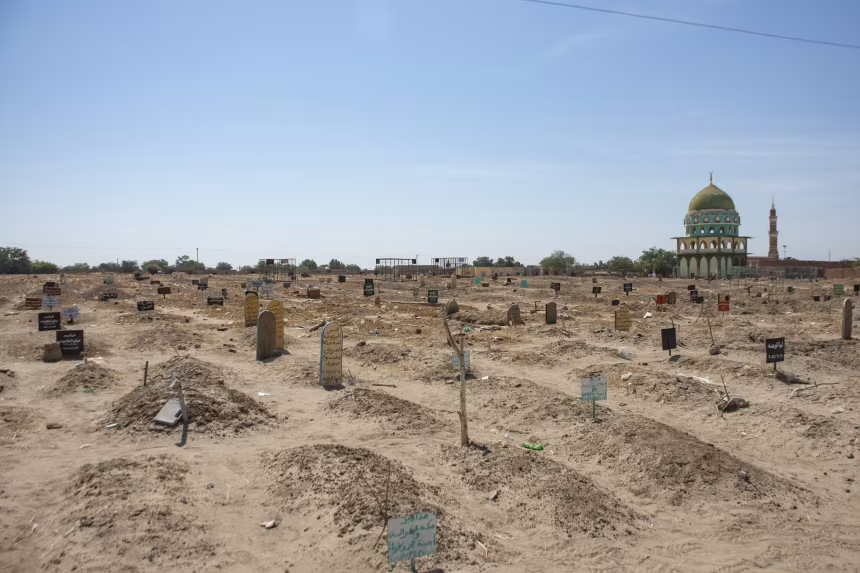
United Nations-backed human rights experts have warned that a brutal October offensive by Sudan’s paramilitary Rapid Support Forces (RSF) against non-Arab communities in El Fasher bears the “hallmarks of genocide,” marking one of the gravest findings yet in Sudan’s nearly two-year war.
In a report released Thursday in Geneva, the independent UN fact-finding mission on Sudan said the RSF carried out a “campaign of destruction” following an 18-month siege of El Fasher, the last remaining stronghold of the Sudanese army in Darfur. The mission said the operation deliberately targeted non-Arab groups, particularly the Zaghawa and Fur communities.
According to UN officials, several thousand civilians were killed during the RSF takeover of the city. Only about 40 per cent of El Fasher’s estimated 260,000 residents managed to flee, many of them wounded, while the fate of thousands of others remains unknown.
Sudan descended into conflict in April 2023 after tensions between military and paramilitary leaders erupted in Khartoum and quickly spread nationwide. The war has officially claimed more than 40,000 lives, though humanitarian groups warn the true toll is likely far higher.
Mass killings and targeted violence
The RSF and allied Arab militias overran El Fasher on October 26, 2025, unleashing widespread atrocities that included mass killings, summary executions, sexual violence, torture and abductions for ransom, the UN Human Rights Office said. More than 6,000 people were reportedly killed in the city between October 25 and 27 alone.
Ahead of the assault, RSF fighters also attacked the Abu Shouk displacement camp on the outskirts of El Fasher, killing at least 300 people over two days.
The RSF did not respond to requests for comment. Its commander, Mohammed Hamdan Dagalo, has previously acknowledged abuses by his forces but disputed the scale of the atrocities.
Genocide criteria met, investigators say
The fact-finding mission concluded that at least three of the five criteria set out in the 1948 Genocide Convention were met. These include killing members of a protected group, causing serious bodily or mental harm, and deliberately inflicting conditions of life intended to bring about the group’s physical destruction, in whole or in part.
The team cited a systematic pattern of ethnically targeted killings, sexual violence and destruction, alongside public statements allegedly calling for the elimination of non-Arab communities.
“These were not random excesses of war,” said mission chair Mohamed Chande Othman. “They point to a planned and organised operation with characteristics of genocide.”
Investigators documented survivor testimonies describing fighters openly threatening to kill members of the Zaghawa community and calling for the elimination of non-Arab populations in Darfur. Women and girls from targeted ethnic groups were reportedly singled out for rape and abuse, while those perceived as Arab were often spared.
Call for accountability
The fact-finding mission, established in 2023 by the United Nations Human Rights Council, called for urgent accountability and warned that civilian protection is now “more critical than ever” as the conflict spreads to other regions of Sudan.
While all sides in the war have been accused of violating international law, the majority of atrocities have been attributed to the RSF. The United States government previously declared that the RSF committed genocide in Darfur.
The RSF has also been accused by UN experts and rights groups of receiving support from the United Arab Emirates, allegations the UAE has repeatedly denied.
The RSF traces its roots to the Janjaweed militias, notorious for atrocities in Darfur in the early 2000s that killed an estimated 300,000 people and displaced millions. UN investigators warn that without decisive international action, history risks repeating itself on an even wider scale.





 Armenian Dram
 Ghana Cedi
 Gambian Dalasi
 Guinea Franc
 Nigerian Naira
 CFA Franc BEAC