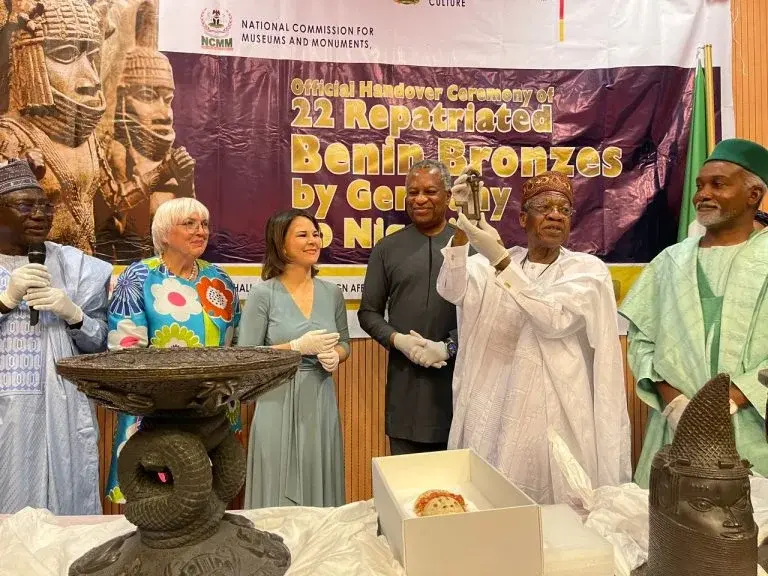
Germany and Nigeria took a significant step forward on Friday by signing an agreement that will see the return of hundreds of artifacts known as the Benin Bronzes, which were taken from Africa over 120 years ago.
Nigerian officials are hopeful that this move will encourage other countries to follow suit and return similar looted treasures.
In recent years, governments and museums in Europe and North America have increasingly worked to address disputes over objects that were taken during colonial times. The Benin Bronzes are a prime example.
In 1897, a British colonial expedition looted a large number of treasures from the royal palace of the Kingdom of Benin, located in what is now southwestern Nigeria.
Among these were numerous bas-reliefs and sculptures, which ended up being scattered around the world.
Many of these artifacts were sold to various collections, including the Ethnological Museum in Berlin, which now holds one of the world’s largest collections of historical objects from the Kingdom of Benin.
This collection includes about 530 items, 440 of which are bronzes dating from the 16th to the 18th centuries.
During the signing ceremony at the German foreign ministry in Berlin, two significant pieces from the Berlin museum were handed over to Nigerian officials. These pieces included a commemorative head of a king and a relief slab showing a king with four attendants.
German Foreign Minister Annalena Baerbock stated that this is just the beginning, as over 1,000 pieces from the Kingdom of Benin remain in German museums.
She emphasized that these items belong to the people of Nigeria and acknowledged the wrongness of taking and keeping the bronzes for 120 years.
She also highlighted that while the bronzes are among Africa’s greatest treasures, they also tell the story of colonial violence.
The Nigerian government, which has been actively demanding the return of the Benin Bronzes in recent years, described this agreement as paving the way for the return of 1,130 pieces. They also called it the “single largest repatriation of artifacts anywhere in the world.”
Nigeria’s Culture Minister, Lai Mohammed, praised Germany for leading the way in correcting past wrongs and expressed hope that this will trigger more repatriations of cultural property worldwide.
Although no specific timeline was provided for the return of the remaining artifacts, the Ethnological Museum in Berlin indicated that an agreement concerning the rest of the bronzes would be reached later this year. Some of these bronzes are expected to stay in Germany on long-term loan. Baerbock mentioned that she looks forward to seeing these bronzes in Germany, perhaps “on holidays.”
The agreement also includes provisions for cooperation between German and Nigerian museums. Germany is assisting Nigeria in establishing a new museum in Benin City, where the returned bronzes will be displayed.
Zubairu Dada, Nigeria’s state minister for foreign affairs, expressed his hope that other European countries would follow Germany’s example.
This move follows similar actions by institutions like the Smithsonian in Washington, D.C., which removed 10 Benin Bronze pieces from display and introduced a new ethical return policy.
Other U.S. museums have also begun discussions about returning such objects.
Last year, France announced its plan to return the Abomey Treasures to Benin as part of a broader effort to address colonial wrongs.
However, many artifacts from the Kingdom of Benin remain in the British Museum in London, which has so far resisted calls for their return.
The British Museum has stated that it remains committed to a thorough and open investigation of the history of its Benin collection, acknowledging the colonial context in which these items were acquired.





 Armenian Dram
 Ghana Cedi
 Gambian Dalasi
 Guinea Franc
 Nigerian Naira
 CFA Franc BEAC