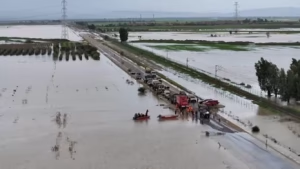
More than 150,000 people have been forced to flee their homes in northern Morocco after days of relentless heavy rainfall triggered widespread flooding across several provinces, authorities have confirmed.
The floods, which have submerged villages, roads and farmlands, have claimed at least four lives so far—including a two-year-old child—while one person remains missing as of Sunday.
For many residents, the evacuation came suddenly. In the village of Ouled Ameur, 67-year-old Kasia El Selami said she learned it was time to flee when an urgent warning was broadcast through loudspeakers at her local mosque as floodwaters rapidly rose.
“We felt immense fear, especially for our children,” Selami said, speaking from a temporary tent where she now lives after being evacuated with her family.
Scenes of desperation played out across the region as rising waters trapped residents on rooftops. Children and elderly people were rescued using small boats, while helicopters were deployed in some areas where roads were completely cut off.
Near the city of Kenitra, about 50 kilometres north of Rabat, authorities have established a sprawling emergency camp made up of hundreds of blue tents, now sheltering nearly 40,000 displaced people. Families there are struggling with limited resources as they wait for conditions to improve and for permission to return home.
Life in the camp reflects the scale of the disruption. Evacuees were seen washing clothes in small basins near enclosures holding rescued livestock, including cows, horses, sheep and chickens. Nearby, men and women queued outside a mobile clinic for medical treatment.
“These are very difficult days,” said Ali Al Aouni, a 60-year-old evacuee, who complained of cold nights and lingering fear among his children. He recalled that floodwaters in his village rose to about one and a half metres, adding that his family is afraid to return home in case the waters surge again.
Civil defence officials say emergency support is ongoing. According to Adil Al-Khatabi, aid being distributed includes mattresses, warm clothing and food, alongside healthcare services and veterinary check-ups for rescued animals.
Despite the hardship, many displaced residents are already hoping to return home. “We are waiting for this ordeal to end as soon as possible so we can go back to our homes,” Selami said.
The latest floods underscore Morocco’s growing vulnerability to extreme weather. In December, sudden flooding in the city of Safi killed 37 people, marking the country’s deadliest weather-related disaster in a decade.
The crisis is part of a wider pattern of severe weather across North Africa and southern Europe. In recent weeks, floods in neighbouring Algeria killed two people, including a child, while Tunisia reported at least five deaths following its heaviest rainfall in more than 70 years. Further north, Portugal and Spain have also been hit by powerful storms and torrential rains.
Authorities in Morocco say emergency services remain on high alert as weather conditions continue to be closely monitored.









 Armenian Dram
 Ghana Cedi
 Gambian Dalasi
 Guinea Franc
 Nigerian Naira
 CFA Franc BEAC