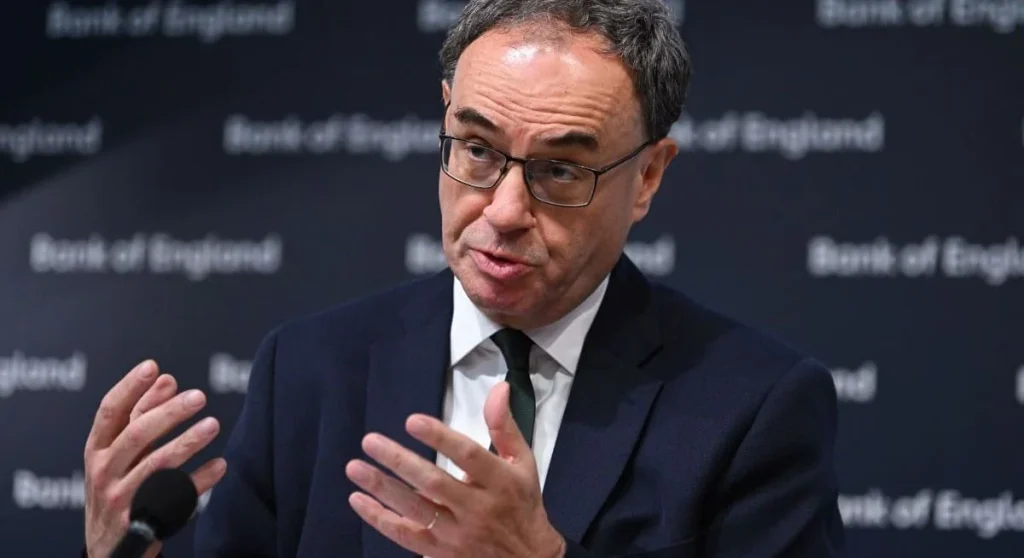
The Bank of England is widely expected to lower interest rates on Thursday, responding to a sharp drop in inflation and signs of economic stagnation. However, economists warn that the UK’s lingering price pressures make a sustained run of further cuts in 2026 unlikely.
Investors anticipate the central bank will reduce its benchmark rate from 4% to 3.75%. This would mark the fourth reduction of 2025 and bring borrowing costs to their lowest level in nearly three years.
A Political and Economic Lifeline
The move would provide welcome relief for Prime Minister Keir Starmer and Finance Minister Rachel Reeves, who are under pressure to deliver on promises of economic revitalization.
Recent data indicates the British economy shrank by 0.1% in the three months leading up to October, largely due to businesses freezing investment ahead of the November budget.
Furthermore, unemployment has climbed to its highest level since 2021.
Despite the anticipated cut, Britain’s interest rate remains nearly double that of the European Central Bank (ECB). The UK continues to grapple with the highest inflation rate among the G7 nations, partly driven by Reeves’ decision to increase taxes on employers last year. Data released Wednesday showed inflation falling to 3.2%, a significant drop but still above target.
A Divided Committee
The decision rests with the BoE’s Monetary Policy Committee (MPC), which has been deeply divided in recent months.
In November, the committee voted 5-4 to keep rates on hold. Analysts polled last week predict a similar split this Thursday, but with the balance tipping 5-4 in favor of a cut, anticipating that Governor Andrew Bailey will switch sides.
Hetal Mehta, chief economist at St. James’s Place, suggests that while the different factions within the MPC are unlikely to change their long-term views, the recent data confirms the “direction of travel.”
“There’s enough ambiguity around some of the numbers going into next year for there not to be back-to-back rate cuts,” Mehta noted. “It’s the magnitude (of rate cuts) that is up for debate.”
Inflation Pressures Persist
While the headline inflation rate has dropped, underlying issues remain. The relief may be short-lived, as budget measures that lowered costs such as removing green levies from power bills and freezing rail fares—are temporary.
Additionally, S&P Global’s Purchasing Managers’ Index released on Tuesday pointed to rising inflationary pressures, suggesting businesses are beginning to pass on costs again. The pace of price increases in the crucial services sector has also slowed only marginally.
Consequently, investors are currently pricing in just one more rate cut for 2026, likely arriving by the end of April. This cautious outlook mirrors trends globally; the U.S. Federal Reserve has signaled only one more cut for 2026, while the ECB appears to have concluded its loosening cycle.
“Gradual, Risk-Managed Shift”
Observers will be scrutinizing the Bank’s statement on Thursday for any changes to its guidance, particularly regarding the “gradual downward path” of borrowing costs.
Daniela Hathorn, senior market analyst at Capital.com, believes policymakers will avoid sounding too aggressive about future reductions.
“Because inflation remains above target and services components still look sticky, policymakers are unlikely to deliver a deeply dovish message,” Hathorn said. “Instead, the BoE is likely to frame any cut as part of a gradual, risk-managed shift rather than a full easing cycle.”
MORE NEWS: Uganda Export Earnings Double to $1.5 Billion in October







 Armenian Dram
 Ghana Cedi
 Gambian Dalasi
 Guinea Franc
 Nigerian Naira
 CFA Franc BEAC