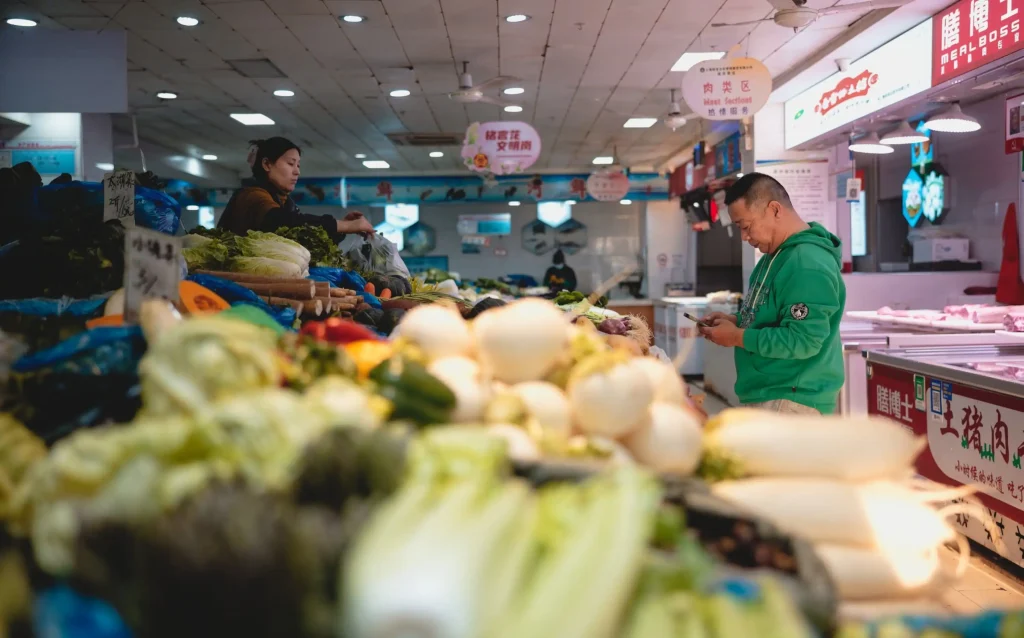
China’s economic recovery hit a major wall last month. Retail sales growth decelerated to its slowest pace in nearly three years.
Official data released on Monday highlights the steep challenge policymakers face. They are struggling to stimulate domestic consumption in the world’s second-largest economy.
The National Bureau of Statistics (NBS) reported the new figures. Retail sales, a primary gauge of consumer spending, rose by just 1.3 percent year-on-year in November.
This represents the weakest performance since December 2022. That period marked the end of strict zero-COVID restrictions.
The figure also fell significantly short of expectations. It missed the 2.9 percent forecast predicted by Bloomberg.
Broad-Based Weakness
The data points to a widening gap. There is a disconnect between China’s export machine and its domestic demand.
The country achieved a historic trade surplus exceeding $1 trillion this year. Robust manufacturing drove this figure, despite trade tensions with the United States. However, local activity is faltering.
Factory activity also showed signs of cooling. Industrial production grew by 4.8 percent in November. This is the slowest rate in over a year.
Zichun Huang, an analyst at Capital Economics, noted the trend. She stated that the data signals “broad-based weakness in domestic activity.”
“External demand for Chinese goods appears to be picking up… but that was offset by weakness in domestic demand,” Huang wrote.
She added a grim forecast. She believes China’s growth is likely to remain weak throughout 2026.
The Property Sector Drag
A prolonged debt crisis in the property market continues to batter consumer confidence. Real estate represents a major store of wealth for Chinese households. Consequently, falling values have made spenders cautious.
The NBS data revealed a stark reality. New residential property prices fell year-on-year in 64 out of 70 major cities surveyed last month.
Zhiwei Zhang, chief economist at Pinpoint Asset Management, explained the impact. He noted a correlation between the housing slump and the retail slowdown.
“The contraction of fixed-asset investment and the drop of property prices… have been transmitted to the consumer sentiment,” Zhang stated.
Fixed-asset investment through the end of November dropped by 2.6 percent compared to the same period in 2024.
Policy Outlook
Economic leaders recently held closed-door meetings. They deliberated strategy for the coming year.
According to state media, officials pledged to stabilize the property market. They also promised to boost consumption and create employment opportunities.
However, economists have long urged Beijing to shift its growth model. They want a move away from manufacturing and exports toward domestic spending.
Zhang predicts that the government may intervene soon.
“I expect fiscal and monetary policies to be loosened somewhat in (the first three months of next year) to stabilise the economic momentum,” he said.
Meanwhile, the surveyed unemployment rate remained unchanged at 5.1 percent for the month.
READ MORE: From Politics to Finance: The African Women Reshaping Global Power








 Armenian Dram
 Ghana Cedi
 Gambian Dalasi
 Guinea Franc
 Nigerian Naira
 CFA Franc BEAC