LAGOS – The money is there, but the “handshake” is missing. That was the resounding message from top financiers at the West Africa Industrialisation, Manufacturing and Trade Forum on Tuesday, as experts warned that persistent policy instability and structural rot are choking the region’s industrial dreams.
Despite a global surplus of investment capital, West Africa’s manufacturing sector remains a “high-risk” zone, with investors demanding astronomical returns to compensate for the unpredictability of operating in the region.
Governance, Not ‘Financial Engineering’
Fabrice Mpollo, Senior Investment Manager at Norfund, pulled no punches, stating that no amount of clever accounting can fix a lack of government discipline.
“The reality of infrastructure project failures here, compared to Asia or Latin America, is rooted in the laws,” Mpollo said. “We forget about financial engineering; governance makes it work. In prospering economies, discipline is settled.”
Mpollo highlighted that operational nightmares—such as chronic port congestion—are currently being subsidized by shareholders rather than solved by policy. He cited cases where companies lost up to $2 million in a single year just paying “rent” on delayed shipments at the port. “That money should go into expansion, not congestion penalties,” he added.
The ‘Infrastructure Bias’ in Funding
A major structural gap was identified by Ufuoma Adasen, Vice President at the Africa Finance Corporation (AFC). While “concessional” and “blended” finance (cheaper, long-term loans) exists, it is almost exclusively funneled into roads and bridges, leaving factory owners to battle high-interest commercial debt.
The Manufacturing Struggle:
-
Import Competition: Local startups without “clout” are being crushed by cheaper, subsidized imports.
-
Bankability Crisis: A lack of “bankable” projects means the time to close a deal in Africa is significantly longer than in other emerging markets.
-
The ‘First-Time’ Penalty: New industrial sponsors struggle to secure equity or debt compared to established infrastructure giants.
“Doubling Down” on Nigeria
Despite the grim diagnosis, the outlook isn’t entirely bleak. Norfund announced it is “doubling down” on Nigeria, citing the sheer scale of the market and the potential of family-owned industrial businesses. The strategy is to move past the risks by deeply understanding the local terrain.
The New Frontier: Green Finance & Local Currency
The forum also touched on two emerging lifelines for the sector:
-
Climate Funding: Investors are increasingly pushing manufacturers toward renewable energy, though “Green Financing” remains difficult for most SMEs to secure.
-
Local Currency Access: There is a growing demand for working capital in Naira, Cedi, and CFA to shield manufacturers from the volatility of the Dollar.
| Investor Concern | The Resulting Impact |
| Port Congestion | Direct financial losses/Shareholder bailouts |
| Policy Inconsistency | Investors demand 2x-3x higher returns |
| Import Dominance | Local first-time sponsors go out of business |
| Lack of Bankability | Capital stays in the bank or moves to other regions |
The consensus was clear: Financial innovation and “blended finance” can only do so much. Until West African governments provide a “cushion” of policy consistency, the region’s industrial revolution will remain a project on paper.





 Armenian Dram
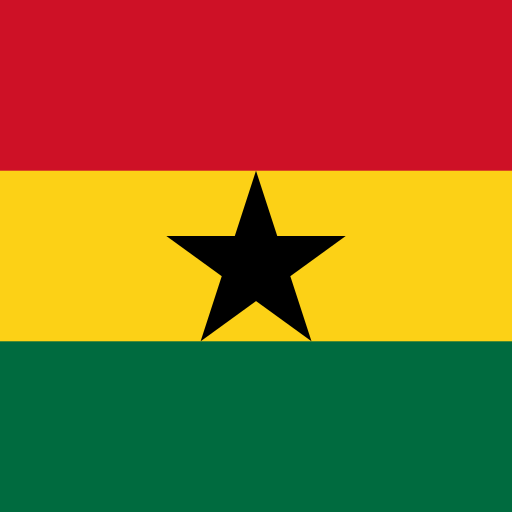 Ghana Cedi
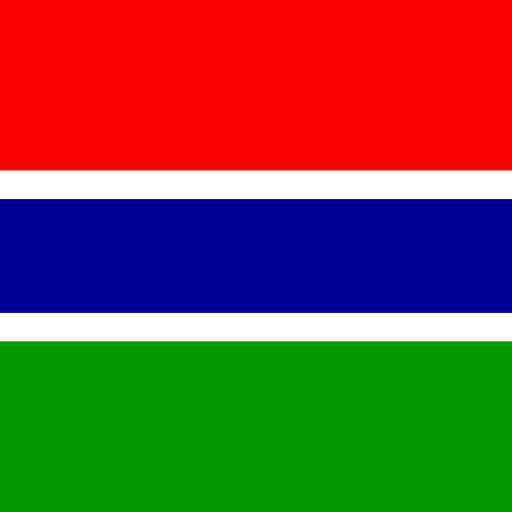 Gambian Dalasi
 Guinea Franc
 Nigerian Naira
 CFA Franc BEAC