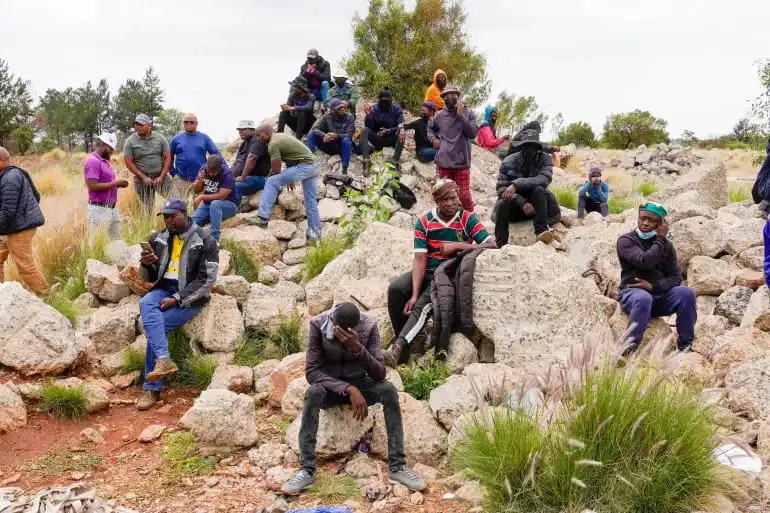
Deep beneath the surface of South Africa’s coal-rich heartland, thousands of informal workers labor in total darkness. Using only pickaxes and raw grit, these miners operate within unauthorized shafts. They remain far removed from the formal industry that currently provides approximately 80% of the nation’s electricity.
In the Mpumalanga province, men like “Cyprial”—a pseudonym used to avoid legal trouble work as the “invisible hands” of the sector. The risks are immense. “You go in knowing the ceiling is solid rock. If it falls, it’s over,” Cyprial says. “You have to take those fears and push them away just to get through the day.”
Artisanal Mining vs. Illegal Activity
Currently, there is a sharp divide in how these workers are perceived. On one hand, the government labels them “illegal miners” and a “menace” to the economy. On the other hand, the workers identify as artisanal miners. They argue that their labor serves a vital community purpose.
According to Jabulani Sibiya, head of a local miners’ union in Ermelo, formal electricity is often too expensive for local residents. Consequently, informal mining provides a much cheaper alternative for cooking and heating homes.
To understand the scale of this industry, consider these figures:
-
Formal Sector: Employs over 100,000 people across the country.
-
Informal Sector: Estimates suggest upwards of 40,000 independent miners operate nationwide, often in abandoned gold or coal sites.
The Challenge of a “Just Transition”
As the world’s 12th largest greenhouse gas emitter, South Africa is now navigating a Just Energy Transition Partnership (JETP). This $8.5 billion deal with wealthy nations aims to shift the country away from fossil fuels toward green energy.
However, in towns like Ermelo, there is a growing fear that this transition will marginalize local workers yet again. Therefore, activists and miners are calling for an inclusive shift.
“A truly ‘just transition’ means moving from large-scale destruction to a sustainable, small-scale mining sector,” explains Zethu Hlatshwayo of the National Association of Artisanal Miners. He argues that even as coal is phased out, artisanal miners could help extract the critical minerals required for solar panels and electric vehicles.
The Fight for Recognition
Miners in Ermelo have already applied for collective mining permits to legitimize their work. However, they describe the bureaucratic process as prohibitively expensive and slow.
For these communities, the message is clear: the green energy revolution must be inclusive. “It will not be a just transition if our people are left behind,” Hlatshwayo warns.
READ MORE: Doumbouya Wins Guinea Election; Opponents Allege “Charade”




 Armenian Dram
 Ghana Cedi
 Gambian Dalasi
 Guinea Franc
 Nigerian Naira
 CFA Franc BEAC