On Monday, December 29, 2025, Beijing initiated its most extensive military maneuvers to date around Taiwan. Labeled “Justice Mission 2025,” these war games aim to demonstrate China’s ability to blockade the island. Specifically, the drills show how Beijing could sever Taiwan’s international support channels during a conflict.
These exercises serve as a high-stakes test of Taipei’s defensive resolve. Furthermore, they evaluate the effectiveness of Taiwan’s recently bolstered arsenal of U.S.-supplied hardware.
Scope and Scale of the Drills
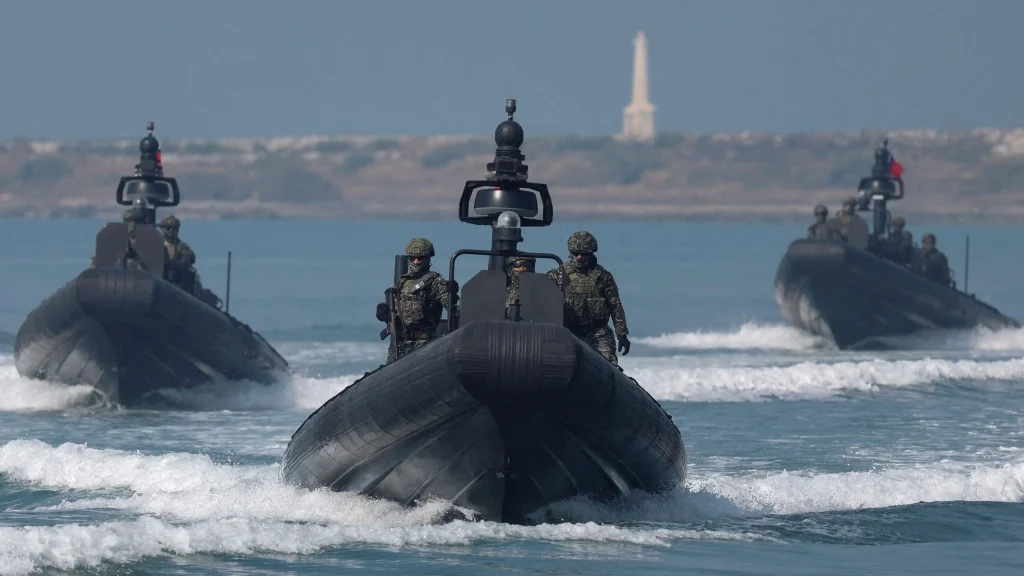
The Eastern Theatre Command has mobilized a massive force for this operation. This includes warships, fighter jets, artillery, and ground troops. The primary objective is a complete encirclement of the island. To achieve this, the military is conducting live-fire drills and simulated strikes on both maritime and land-based targets.
Key details of the maneuvers include:
-
Seven Designated Zones: The Maritime Safety Administration marked a record seven zones for live-fire exercises. Consequently, these forces are positioned closer to Taiwan’s coast than in any previous drills.
-
Port Blockades: Specific drills focus on sealing off the Port of Keelung in the north and Kaohsiung in the south, which is the island’s largest port.
-
Civilian Disruption: The activity has caused significant travel issues. Over 100,000 international passengers face delays, and approximately 80 domestic flights have been cancelled.
Futuristic Tech and Military Hardware
In a notable departure from previous exercises, Beijing showcased advanced, futuristic weaponry. State media released footage featuring automated humanoid robots, microdrones, and weaponized robotic dogs participating in simulated assaults.
Taiwan’s Defensive Response
Taiwan’s Ministry of National Defense countered with its own displays of strength. The military highlighted its HIMARS rocket systems. These systems possess a 300 km range, which is capable of reaching China’s Fujian province across the strait.
Monday’s Deployment Figures
To replace earlier data summaries, here is the breakdown of the Chinese assets spotted during the first day of drills:
- Military Aircraft: 89 units
- Military Vessels: 14 units
- Coast Guard Boats: 14 units
- Additional Warships: 4 units (spotted in the Western Pacific)
Geopolitical Tensions and “External Interference”
Analysts suggest the timing and intensity of the drills are a direct response to two major international developments. First, the U.S. recently approved a record $11.1 billion weapons package for Taiwan. Second, recent comments from Japanese leadership regarding military support for Taiwan have drawn sharp rebukes from Beijing.
“Our armed forces operate on the principle of preparing for the worst,” stated Hsieh Jih-sheng, deputy chief of the general staff for Taiwan. He emphasized that these drills pose complex challenges for the entire international community, not just for Taiwan.
Market Stability and Public Sentiment
Despite the looming military presence, the Taiwan stock market remained resilient. It closed up 0.9% on Monday. In Taipei, many residents appeared unfazed. They view the exercises as a recurring psychological tactic rather than an immediate threat.
“I think these drills are just meant to scare us,” said Lin Wei-ming, a local teacher. He added that similar drills have happened before and that the ultimate response lies with the government.
As the live-fire exercises continue through Tuesday, Taiwan’s military remains on high alert. Troops are prepared for “rapid-response” maneuvers should the simulated blockade transition into a real-world assault.
READ MORE: Moscow Explosion: Two Police Officers Killed in Overnight Blast








 Armenian Dram
 Ghana Cedi
 Gambian Dalasi
 Guinea Franc
 Nigerian Naira
 CFA Franc BEAC