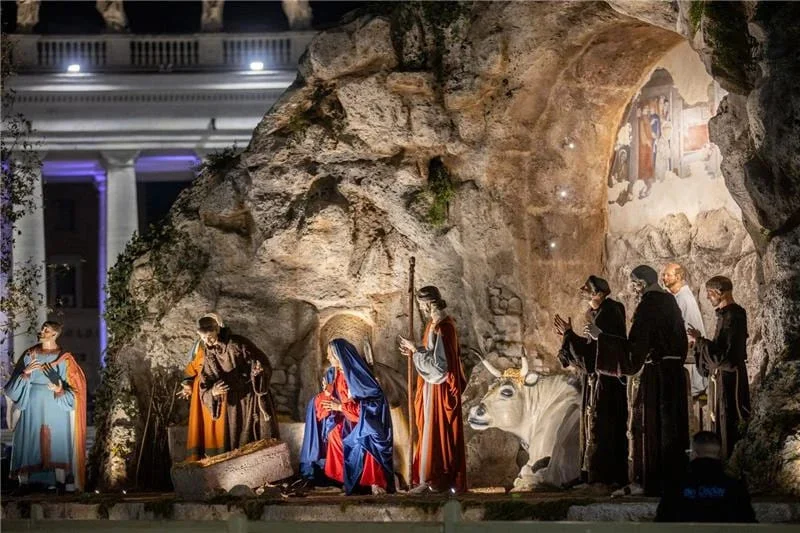
With Christmas just around the corner, St. Peter’s Square has transformed into a global village of faith and artistry.
The Vatican is currently hosting the 8th edition of its celebrated international exhibition, bringing the story of Jesus’ birth to life through the lens of diverse cultures. The showcase, titled “100 Nativity Scenes in the Vatican,” is nestled within the historic Bernini colonnade.
This year’s collection features over 130 distinct works hailing from at least 22 different nations. The displays go far beyond the traditional manger, with artists utilizing local materials and customs to reinterpret the sacred scene.
A Global Mosaic of Faith
The creativity on display is staggering. Organizers have curated a mix that prioritizes originality and cultural expression.
- Ethiopia: A striking scene carved entirely from African rosewood.
- Taiwan: An elegant, traditional depiction crafted from fine ceramics.
- South Korea: A minimalist ceramic interpretation of Mary and Jesus.
- Italy: A highly unconventional display set inside a leather tanning drum, mixing straw and ceramic.
- The Tiny & The Modern: One artist managed to construct a full nativity inside a lightbulb, while Rome’s public transport authority contributed a scene set inside a city bus.
A Message Beyond Art
Monsignor Salvatore Rino Fisichella, Archbishop and Pro-Prefect of the Dicastery for Evangelization, emphasized that the exhibition is about more than just aesthetics.
“The most important thing is the message that comes from these nativity scenes,” Fisichella explained.
He described the collection as a symbol of true international unity. “It means a message of hope, a message of peace and, like every Christmas, a message that obliges us to recognise ourselves, to respect and to love each other a little bit more.”
Pilgrims React
For visitors, the exhibition offers a chance to see the Gospel through new eyes. Aniko Schnider, a tourist from Hungary, noted how the displays reflect the universality of faith.
“You can see the difference on how we interpret the scene of nativity in different cultures,” Schnider said. “It is a possibility to reflect on the way the Gospel… was interpreted by different cultures.”
Bartosz Golebiowki, visiting from Poland, was equally moved. “It’s beautiful! I’m from Poland and in our country… we don’t have so much ‘presepi’,” he said, using the Italian term for nativity scenes.
The exhibition is free to the public and will remain open until January 8, 2026.
ALSO READ: Milano Cortina 2026: IOC Board Convenes









 Armenian Dram
 Ghana Cedi
 Gambian Dalasi
 Guinea Franc
 Nigerian Naira
 CFA Franc BEAC