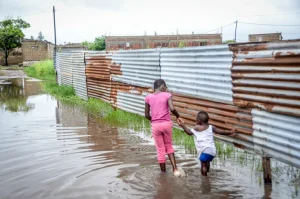
Maputo, Mozambique — Survivors of devastating floods across southern and central Mozambique are struggling to rebuild their lives after weeks of relentless rainfall left more than 150 people dead and about 800,000 displaced or affected, according to authorities.
Among them is Emilia Machel, a 30-year-old mother of three from Chokwe in Gaza Province, who fled her home on January 17 as floodwaters from the Limpopo River surged through her community. Heavy rains across Southern Africa had pushed the river to dangerous levels, submerging entire neighbourhoods.
“I had to leave everything behind,” said Machel, who earns a living selling tomatoes and onions. She and her children sought refuge at Chiaquelane, a long-established displacement centre that has sheltered flood victims for decades.
For Machel, this is a painful recurrence. She first arrived at Chiaquelane as a child during Mozambique’s catastrophic floods in 2000, and again during floods in 2013. “We came here because we know it is safer,” she said. “But it is tormenting to have to return every time it rains like this.”
Worst Flooding in Decades
Authorities say the current flooding ranks among the worst in decades. Although rainfall has eased and river levels have begun to fall, vast areas remain underwater, leaving communities isolated and infrastructure destroyed.
“In some places, it feels like flying over the ocean,” said Guy Taylor, UNICEF’s chief of communications. “Water stretches for long distances, with homes completely cut off.”
Mozambique’s meteorological agency, INAM, has warned that moderate rainfall is expected to continue in northern provinces, raising fears of further flooding.
The government estimates that hundreds of millions of dollars’ worth of infrastructure have been damaged. In several areas, residents remain stranded and require rescue.
Economic and Urban Impact
The floods have hit Gaza Province, one of Mozambique’s key agricultural regions, particularly hard. Hundreds of hectares of farmland and food storage facilities have been washed away, deepening food insecurity.
In Xai-Xai, the provincial capital, businesses remain submerged. “It is still difficult to measure the full impact,” said Paula Fonseca, a local business owner whose restaurant remains underwater.
Urban flooding has also devastated Matola, Mozambique’s most populated city. Mayor Julio Parruque described it as the city’s most severe flooding in years, worsened by overcrowding and unplanned construction that blocked drainage systems. Thousands of residents have been forced into temporary shelters.
Even in the capital, Maputo, several neighbourhoods remain inaccessible, with homes still submerged.
Warnings Issued, But Evacuations Lagged
INAM had warned for months of heavy rainfall during the 2025–2026 rainy season, but many residents delayed evacuating, fearing looting or uncertain about where to go.
“We waited until there was nothing else to do but leave,” Fonseca said.
Critics argue that warnings alone are not enough. Carmo Vaz, a retired hydrologist, said authorities must do more to actively relocate communities before floods strike, rather than relying solely on alerts.
Strain on Aid and Rising Health Risks
Displacement centres like Chiaquelane are overstretched. Machel says conditions are harsh, with families sleeping on mats and relying entirely on aid for food.
“We eat porridge in the morning and rice and beans later in the day,” she said. “Sometimes there is no third meal.”
UNICEF estimates that children make up nearly half of those displaced, raising alarm over malnutrition and disease outbreaks. “Waterborne diseases are a major concern, especially for malnourished children,” Taylor said, noting that four in 10 children in Mozambique were already chronically malnourished before the floods.
Sanitation remains a major challenge in overcrowded shelters, increasing health risks.
Communities Show Resilience Amid Crisis
Despite limited resources, communities have stepped up to support one another. “Even people with very little are helping others,” Fonseca said.
International support has also arrived, with neighbouring countries and global partners sending rescue teams, food supplies, and emergency shelter kits. However, UN agencies warn that funding gaps remain significant, as Mozambique also grapples with an ISIL-linked insurgency in the north that has displaced hundreds of thousands.
‘We Must Rebuild’
Mozambique is among the countries most vulnerable to climate-related disasters. At the recent COP30 climate summit in Brazil, the government said it needs more than $30 billion by 2030 to fund climate adaptation efforts.
For Machel, the focus remains on survival and recovery. Her husband is stranded in another flooded area, and her home has been swept away. Still, she remains determined.
“It is very sad what is happening,” she said. “But we have to rebuild and go back home.”


 Armenian Dram
 Ghana Cedi
 Gambian Dalasi
 Guinea Franc
 Nigerian Naira
 CFA Franc BEAC