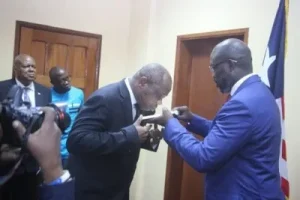
Liberia’s anti-corruption drive reached a decisive moment this week as the Supreme Court of Liberia ruled that former Finance Minister Samuel Tweah and several other ex-officials are not protected from prosecution under claims of National Security Council (NSC) immunity.
By rejecting a petition for re-argument, the court upheld its December 18, 2025 opinion and ordered the case to proceed in Criminal Court “C” in Montserrado County. The decision removes a key legal hurdle that had stalled one of the country’s most politically sensitive corruption cases.
Court rejects immunity argument
At the center of the dispute was whether officials who served on or alongside the NSC could invoke immunity similar to that granted to the President under Article 61 of Liberia’s 1986 Constitution. The Supreme Court’s answer was unequivocal: such immunity applies only to the President while in office.
The defense argued that the court had overlooked provisions of the National Security Reform and Intelligence (NSRI) Act, particularly those listing the Minister of Finance as a member of the NSC. While the court acknowledged a minor citation error in its earlier ruling, it stressed that the mistake did not affect its conclusion.
“That inadvertence does not affect the conclusion of the Court’s opinion,” the justices said, emphasizing that the defendants do not enjoy presidential immunity. Under the court’s rules, re-argument is permitted only where a substantial error alters the outcome—something the justices said did not occur.
Alleged misuse of public funds
Prosecutors allege that in September 2023, US$500,000 and L$1.055 billion were transferred from the Central Bank of Liberia to operational accounts of the Financial Intelligence Agency and later withdrawn without proper authorization.
Those facing trial alongside Tweah include former Acting Justice Minister Nyanti Tuan, former FIA Director General Stanley S. Ford, former Financial Comptroller D. Moses P. Cooper, and former National Security Adviser Jefferson Karmoh. They are charged with economic sabotage, misuse of public money, theft of property, money laundering, criminal facilitation, and criminal conspiracy.
The defense maintains that Section 11(d) of the NSRI Act permits national security expenditures outside standard financial procedures when vital interests are at stake. Prosecutors counter that there was no documentary authorization from the NSC or related bodies to justify the transfers.
Broader implications
Legal experts say the ruling reinforces the principle that public office does not place officials above the law. In a key passage, the court stated that no separation-of-powers or political-question doctrine prevents Liberian courts from examining alleged criminal misuse of public funds—making clear that national security cannot be used as a blanket shield against judicial scrutiny.
The decision also narrows the scope of presidential immunity, avoiding what analysts warn could have become a doctrine of “derivative immunity” extending protection to ministers and senior officials.
The case is being closely watched by anti-graft agencies, including the Liberia Anti-Corruption Commission, as well as development partners pressing for greater fiscal transparency.
As the trial resumes, observers say its outcome could either bolster public confidence in judicial independence or deepen skepticism if it falters on evidence or procedure. Beyond the courtroom, the case has already reignited debate over oversight of national security spending and whether existing laws leave too much room for abuse.
For now, the Supreme Court has drawn a clear constitutional line: national security is not a sanctuary for alleged financial misconduct. The spotlight now shifts to Criminal Court “C,” where the merits of the case will be tested.





 Armenian Dram
 Ghana Cedi
 Gambian Dalasi
 Guinea Franc
 Nigerian Naira
 CFA Franc BEAC