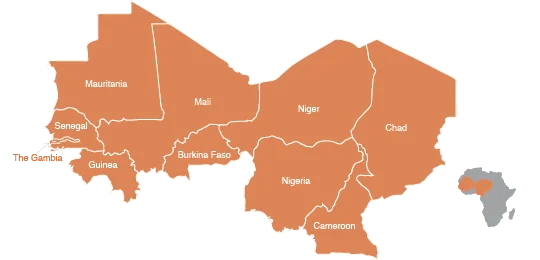
The U.N. humanitarian chief is hoping a major meeting on Tuesday will not only raise $1 billion for three African countries facing a serious humanitarian crisis but also encourage leaders to tackle the root causes of the problem. These causes include increasing conflict, insecurity, poor governance, and a lack of development.
Mark Lowcock, the U.N. Undersecretary-General, explained in an interview that the worsening situation in Burkina Faso, Mali, and Niger is a result of failing to address these issues, as well as rapid population growth and climate change.
Because of this, more than 13 million people in these border regions need humanitarian aid, with most of them being children.
The virtual meeting, hosted by Denmark, Germany, the European Union, and the United Nations, aims to highlight one of the world’s fastest-growing humanitarian crises. Lowcock hopes it will increase aid funding and focus more on finding long-term solutions.
“This meeting is timely because things are getting worse very quickly,” he said. “Without action, the situation will worsen, and more lives will be lost.”
The U.N. says that of the $1.4 billion needed for humanitarian aid in these three countries this year, only 39% has been funded.
Around 7.4 million people are currently struggling with severe food insecurity, which is three times more than last year. These people don’t know where their next meal will come from and face acute malnutrition.
Food insecurity has dramatically increased by 514% in Burkina Faso, 130% in Mali, and 144% in Niger compared to the last five years.
Lowcock hopes the conference will raise close to $1 billion for 2020, which would help manage the crisis and prevent the worst outcomes. However, he stressed the importance of maintaining this support through 2021 and 2022.
He pointed out that it will take time to solve the problems in the central Sahel region, and leaders need to commit to long-term engagement. Governments in these countries need to regain control of areas now dominated by extremist groups, but Lowcock emphasized that this must be done carefully to avoid making the situation worse.
The Sahel is the only region where all U.N. human development indicators are declining. Lowcock called for more education for girls, reduced infant and maternal deaths, and better access to clean water.
He also said traditional livelihoods like farming and livestock grazing can no longer support the growing population, especially with climate change. For example, Lake Chad has dramatically shrunk.
Many countries have transitioned from rural, agriculture-based economies to city-based ones over the last few hundred years, and there are models that Sahel countries can follow. However, these solutions are not yet being effectively applied.
Lowcock warned that Burkina Faso, Mali, Niger, and neighboring countries like Cameroon, Chad, and Nigeria, are at risk of reaching a “tipping point” where problems become much harder to fix. He compared it to a snowball rolling downhill, noting that the number of displaced people in these areas has skyrocketed from 70,000 in 2018 to 1.5 million in 2020.
This year has also seen record floods and the highest number of people needing aid, along with a surge in attacks on aid workers and an expansion of extremist groups’ influence.
Lowcock stressed that these challenges won’t be solved quickly, but progress can only be made if the problems are recognized and solutions are discussed.
“You don’t get to choose where to start, but you have to take the first step,” he said.
Lowcock continued by emphasizing that unless leaders and international organizations take action now, the situation in the Sahel will continue to spiral out of control. He warned that delaying efforts will only make the problems worse, leading to more displacement, hunger, and suffering.
He expressed concern that extremist groups are expanding their control over more areas and that their influence is harmful to the lives of ordinary people. These groups often prevent aid from reaching those who need it most and create an environment of fear and instability.
To move forward, Lowcock called for long-term strategies focused not just on emergency aid but also on addressing the root causes of the crisis. These include improving governance, providing education and healthcare, and helping people adapt to climate change. He pointed out that without such efforts, the region will continue to struggle with poverty, violence, and insecurity.
Lowcock also highlighted the importance of international cooperation, urging countries and organizations around the world to stay engaged and provide support over the coming years. He mentioned that other countries have successfully transitioned from crisis situations to stable development, and similar approaches could help the Sahel region.
The U.N. humanitarian chief ended the interview by stressing the urgency of taking the first steps toward lasting solutions. “If we don’t act now,” he said, “the situation will become even harder to manage, and millions more lives will be at risk.”




 Armenian Dram
 Ghana Cedi
 Gambian Dalasi
 Guinea Franc
 Nigerian Naira
 CFA Franc BEAC