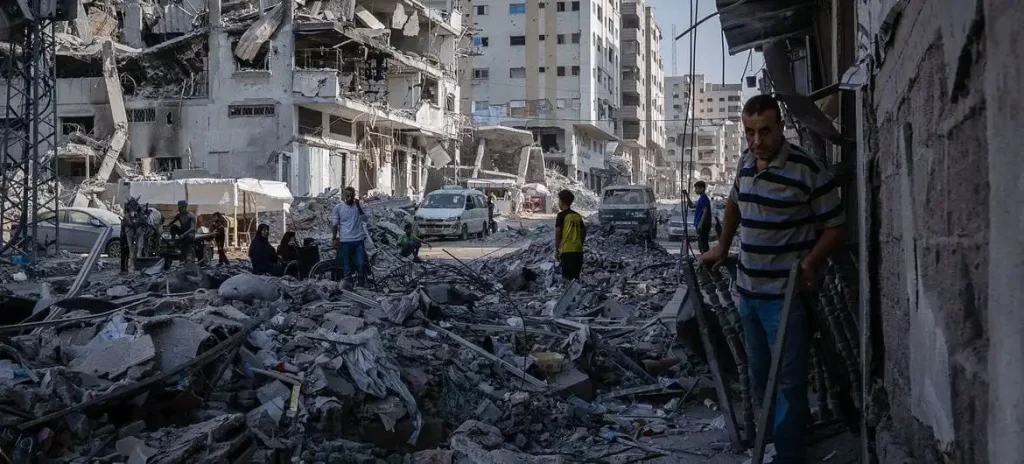
Storm Byron lashed the Gaza Strip on Thursday. Freezing winds and torrential rain turned tent camps into mud-choked swamps.
The storm highlights a grim reality. Two months of ceasefire have failed to solve the territory’s humanitarian crisis.
As the storm descended, conditions deteriorated rapidly. Children walked through brown floodwaters that swallowed their sandals. Trucks moved slowly to avoid sending waves of sludge into fragile shelters.
In many areas, uncollected garbage and sewage mixed with the rain. This created hazardous waterfalls that flowed directly through living quarters.
A Crisis of Shelter
The severe weather exposes the devastation of the two-year war. Most of Gaza’s homes and infrastructure are destroyed.
Displaced families rely on cesspits dug near their tents for sanitation. These pits cannot handle the flooding.
Ahmad Abu Taha lives in a tent near the beach. He described the situation as catastrophic.
”Water flooded all the tents here. There was a tent that was washed away,” Taha said. “Conditions are very bad, we have old people, displaced, and sick people inside this camp.”
The Palestinian Civil Defense reported a surge in emergencies. They received over 2,500 distress calls regarding damaged shelters since the storm began.
The Aid Discrepancy
Aid delivery remains a major problem. Under the current truce, Israel promised to allow 600 trucks of aid daily into Gaza.
However, aid groups dispute whether Israel is meeting these targets.
- Israel’s Claim: COGAT, the Israeli military body, claims it recently allowed 260,000 tents and 1,500 trucks of warm clothing into Gaza. They provided no evidence for these figures.
- Aid Groups’ Data: The Shelter Cluster contradicts this. They report that UN agencies have delivered only 15,590 tents since the truce began. Other nations sent about 48,000.
Amjad al-Shawa is the Gaza chief of the Palestinian NGO Network. He stated that only a fraction of the 300,000 tents needed have actually arrived. Furthermore, many existing tents lack proper insulation.
Calls for Action
Senior Hamas official Khaled Mashaal called for urgent help. He demanded the entry of heavy machinery to clear rubble and the opening of the Rafah crossing.
Meanwhile, al-Shawa accused Israel of blocking essential equipment. He specifically mentioned water pumps needed to clear flooded shelters.
“All international sides should take the responsibility regarding conditions in Gaza,” al-Shawa said. “There is real danger for people in Gaza at all levels.”
COGAT did not immediately respond to requests for comment regarding the water pumps.
A Stark Contrast
Heavy rains also fell across Israel on Thursday. However, no major emergencies were reported there. This contrast highlights the profound damage to Gaza’s infrastructure.
The UN agency for Palestinian refugees (UNRWA) issued a health warning.
“Cold, overcrowded, and unsanitary environments heighten the risk of illness and infection,” the agency stated.
Share your thoughts below: Beyond Rice Imports: Nigeria and Thailand Forge New ‘Strategic Partnership’








 Armenian Dram
 Ghana Cedi
 Gambian Dalasi
 Guinea Franc
 Nigerian Naira
 CFA Franc BEAC