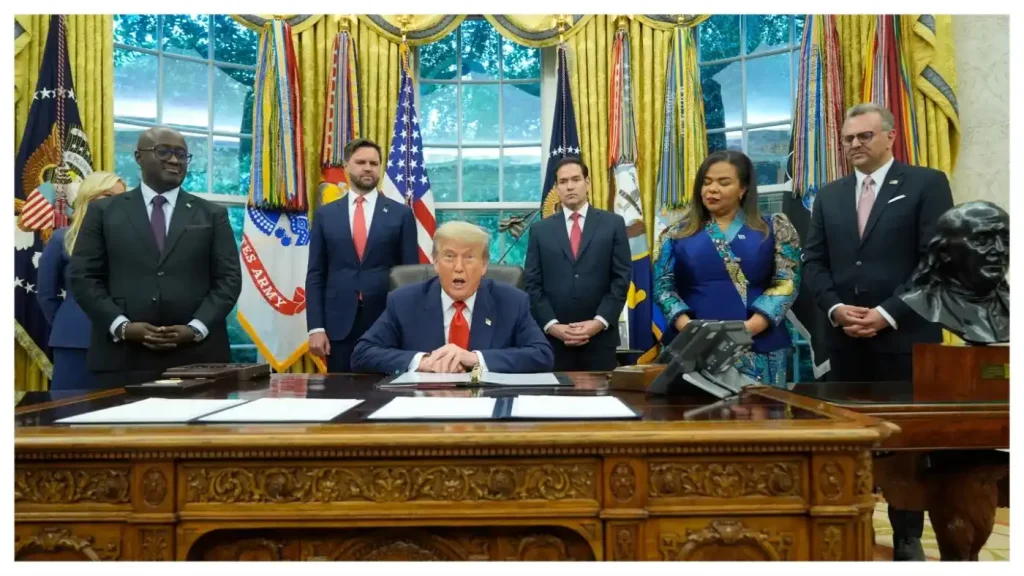
Rwanda and the Democratic Republic of Congo (DRC) are set to sign a major peace accord. United States President Donald Trump will host the leaders of both nations in Washington on Thursday.
This high-profile ceremony aims to end years of conflict. However, fresh accusations of ceasefire violations threaten to overshadow the diplomatic breakthrough.
Presidents Paul Kagame and Félix Tshisekedi will sign the “Washington Accords for Peace and Prosperity.” This agreement is the result of months of US-brokered negotiations.
Diplomatic Hopes vs. Ground Reality
Rwandan officials expressed hope regarding the new deal. Foreign Minister Olivier Nduhungirehe described it as a critical step toward stability.
Speaking in Washington, he emphasized progress on the ground despite recent skirmishes.
“Peace is a process,” Nduhungirehe stated. He credited President Trump for introducing an economic incentive for peace. The deal aims to attract billions in Western investment to the region. The area is rich in minerals like gold, cobalt, copper, and lithium.
However, the situation in eastern DRC remains tense. Just days before the signing, the Congolese army and M23 rebels traded heavy accusations. Each side blamed the other for sabotage and violating the ceasefire.
The Sticking Points: M23 and FDLR
Nduhungirehe accused the Congolese military of aggression. He cited the use of fighter jets and drones against M23 positions and civilians.
Furthermore, he addressed the presence of Rwandan troops inside DRC territory. He described this deployment as a “defensive measure.” He insisted forces would only withdraw once Congolese authorities neutralize the FDLR.
The FDLR is a militia group linked to the 1994 genocide against Tutsis in Rwanda. Kigali views them as a severe security threat.
“We are yet to see any beginning of operations against the FDLR,” Nduhungirehe noted. He questioned the DRC’s good faith in the process.
Kinshasa’s Stance
In response, the DRC government defended its actions. Minister of Communications Patrick Muyaya stated that the government has started an awareness campaign. This is a precursor to disarming FDLR fighters.
Muyaya blamed the recent violence squarely on the M23 rebels. He argued that the clashes prove “Rwanda doesn’t want peace.”
Nevertheless, he expressed optimism about US involvement. He hopes the Trump administration can turn the paper agreement into reality.
“Peace for us means the withdrawal of Rwandan troops,” Muyaya said. He added that it also means stopping all support for the M23 rebels.
Elon Musk Calls for Reform, Not Removal, of H-1B Visa Program




 Armenian Dram
 Ghana Cedi
 Gambian Dalasi
 Guinea Franc
 Nigerian Naira
 CFA Franc BEAC