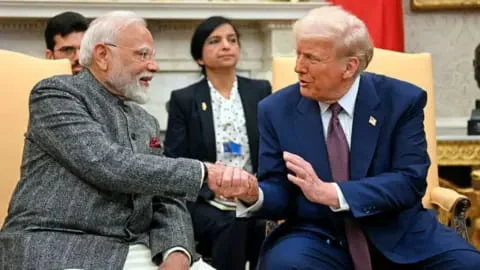
In a blunt assessment of failed international diplomacy, U.S. Commerce Secretary Howard Lutnick revealed that a historic trade agreement with India collapsed because Prime Minister Narendra Modi did not personally call President Donald Trump to finalize the terms.
Speaking on the All-In podcast, Lutnick described a missed opportunity where technical negotiations were complete, but the “closer”—President Trump—never received the required leader-to-leader confirmation from New Delhi.
The “Shot Clock” and the Staircase Model
Lutnick explained that the Trump administration utilizes a “staircase” model for trade. Under this system, the first nations to sign receive the most favorable terms, while those who hesitate face progressively higher tariff “stairs.”
India was reportedly placed on a strict “short clock” of three weeks (or “three Fridays”) to secure a deal following the United Kingdom’s successful agreement.
- The Comparison: While UK Prime Minister Keir Starmer personally called Trump to seal their pact, India remained silent.
- The Consequences: After India missed the deadline, the U.S. moved on to sign agreements with Indonesia, the Philippines, and Vietnam at significantly higher tariff rates.
- The “Expired” Offer: When Indian officials later indicated they were ready to proceed, Lutnick informed them the original terms had already “left the station.”
Retaliatory Tariffs and Economic Pressure
The breakdown in communication has had immediate financial repercussions. In August 2025, the U.S. doubled tariffs on Indian imports to 50%, citing India’s continued purchase of Russian oil as a primary provocation.
The pressure is now escalating. This week, President Trump approved a Russia Sanctions Bill that could see tariffs skyrocket to 500% for nations that continue to fund the Russian energy sector.
- Market Reaction: The Indian rupee fell to an all-time low following the news.
- Investor Sentiment: Uncertainty regarding the “expired” deal has led to a cooling of foreign investment in Indian manufacturing.
Why the Call Never Happened
Sources within the Indian government suggest that the reluctance was not a matter of policy, but of diplomatic optics. Officials reportedly worried that a direct call between the two leaders might become a one-sided negotiation, potentially forcing the Prime Minister to make immediate concessions on sensitive geopolitical issues on a recorded line.
While Lutnick noted that “India will work it out” eventually, he made it clear that the most favorable window for a deal has officially closed.
Similarly, Chinese AI & Chip Firms Raise $1.19B in Hong Kong Debut





 Armenian Dram
 Ghana Cedi
 Gambian Dalasi
 Guinea Franc
 Nigerian Naira
 CFA Franc BEAC