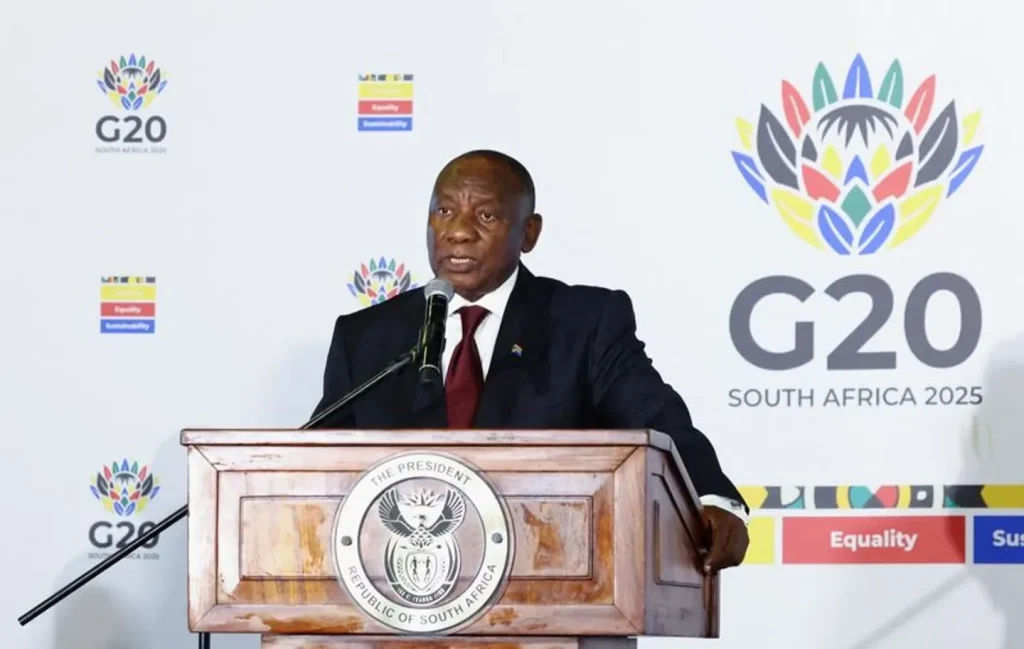
The scene set for the upcoming Group of 20 (G20) summit next week in South Africa is one of sharp diplomatic tension. On Friday, South African President Cyril Ramaphosa confirmed he will symbolically hand over the G20 presidency to an “empty chair” at the summit, acknowledging the confirmed absence of U.S. leadership.
This dramatic situation follows U.S. President Donald Trump‘s declaration last week. Trump stated that no government official would attend the November 22–23 gathering in South Africa. The reason given was alleged “human rights abuses” in the host nation.
The “Genocide” Claims
President Trump’s allegations centered on widely debunked assertions that white South Africans, specifically Afrikaners (descendants primarily of Dutch settlers), are being “slaughtered” and illegally driven off their land. He also stated that refugee admissions to the U.S. this year would be focused largely on this white minority group.
South African officials have expressed increasing exasperation with these claims of ethnic cleansing. They firmly deny that any citizen in the Black-majority country faces discrimination based on their race.
Responding to reporters in Soweto, where he was overseeing preparations for the summit, Ramaphosa addressed the diplomatic slight directly.
“I have said in the past, I don’t want to hand over to an empty chair,” Ramaphosa noted. “But the empty chair will be there, (I will) probably symbolically hand over to that empty chair and then talk to President Trump…”
Prioritizing Economic Ties
Despite the political controversy, Ramaphosa emphasized his main objective is to maintain strong economic ties with the United States, which remains one of South Africa’s largest trading partners.
“We export products to that country that in the end don’t end up in the White House. They end up in the hands of consumers in the United States,” he argued.
The South African leader acknowledged the pressure to retaliate but maintained a pragmatic stance on diplomacy. “There could well be a view that we should not engage with the United States,” he said. He concluded that sometimes a country must engage with even “unfriendly” parties to advance its own national interests.


 Armenian Dram
 Ghana Cedi
 Gambian Dalasi
 Guinea Franc
 Nigerian Naira
 CFA Franc BEAC