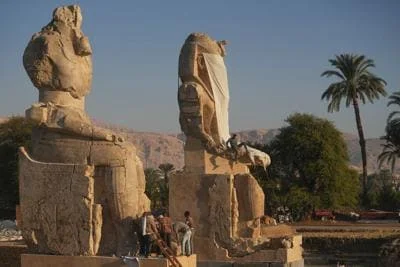
Egypt has officially unveiled two fully restored colossal statues in the southern city of Luxor. These statues honor a prominent pharaoh, Amenhotep III.
This event marks the government’s latest effort to draw more tourists. It highlights the country’s vast archaeological treasures.
The giant alabaster figures are known as the Colossi of Memnon. They were reassembled during a massive renovation project. This effort spanned nearly two decades.
The statues depict Amenhotep III. He ruled ancient Egypt approximately 3,400 years ago.
Mohamed Ismail, secretary-general of the Supreme Council of Antiquities, spoke on Sunday.
“Today we are celebrating, actually, the finishing and the erecting of these two colossal statues,” Ismail said.
He noted the project’s goal. It aims to “revive how this funerary temple of king Amenhotep III looked like a long time ago.”
A Legacy of Prosperity
Amenhotep III is considered one of Egypt’s most significant rulers. He reigned for nearly four decades (1390–1353 BC).
This period occurred during the New Kingdom. It was a golden era of peace and prosperity.
Great construction projects defined his rule. These included the temple of Soleb in Nubia. They also included his vast mortuary temple in Luxor, where the Colossi stand.
However, a powerful earthquake struck roughly 1,200 years ago. It toppled the statues and destroyed much of the funerary temple.
The statues were fragmented. Their pedestals were dispersed. Over centuries, builders even reused some blocks in the nearby Karnak temple.
Fortunately, archaeologists have now retrieved these pieces. They used them to rebuild the monuments.
The Restoration Mission
In the late 1990s, an Egyptian-German mission began the work. Led by Egyptologist Hourig Sourouzian, they started the arduous task of saving the site.
“This project has in mind … to save the last remains of a once-prestigious temple,” Sourouzian explained.
The restored statues show the pharaoh seated. His hands rest on his thighs. They face eastward, looking toward the Nile and the rising sun.
- Height: The statues stand at 14.5 meters and 13.6 meters respectively.
- Material: Builders hewed them from Egyptian alabaster sourced from Hatnub quarries.
- Details: The pharaoh wears the nemes headdress and a double crown. Two smaller statues at his feet depict his wife, Tiye.
The 35-hectare temple complex is massive. Experts believe it is the largest and richest in Egypt.
Boosting Tourism
This unveiling comes at a strategic time. It is just six weeks after the inauguration of the Grand Egyptian Museum near the Giza Pyramids.
This is part of a broader strategy. The government wants to revitalize the tourism sector. This industry is vital for Egypt’s economy.
The sector has faced challenges recently. These include the 2011 uprising, the COVID-19 pandemic, and global conflicts.
However, recovery is underway.
“This site is going to be a point of interest for years to come,” said Sherif Fathy, the Minister of Tourism and Antiquities. “There are always new things happening in Luxor.”
Official figures show positive trends. A record 15.7 million tourists visited Egypt in 2024.
Minister Fathy expects this number to rise to 18 million this year. The long-term goal is 30 million visitors annually by 2032.
READ ALSO: UK Cuts Free Schools for Special Needs Cash






 Armenian Dram
 Ghana Cedi
 Gambian Dalasi
 Guinea Franc
 Nigerian Naira
 CFA Franc BEAC