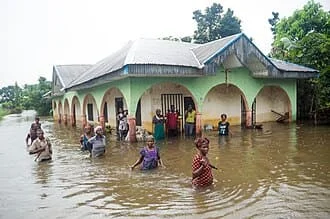
Deep within the giant swamps of South Sudan, the Akuak people are fighting a battle against nature.
Living in an area known as the “toich,” families spend hours every day rebuilding the ground beneath their feet.
For this community, life is defined by water, grass, and papyrus. In the past, flooding was seasonal. Waters would recede during the dry months of November to January.
However, recent years have brought a permanent shift. Years of consecutive, record-breaking floods have altered the geography of the Sudd, Africa’s largest wetland. Experts believe rising sea temperatures are driving heavier rainfall in East Africa. This has caused the floodplain north of Bor to expand permanently.
Adapting to Survive
In 2020, catastrophic floods hit Jonglei state. Many communities were forced to flee with their cattle. However, the Akuak people had already begun adapting decades ago.
Like all Dinka communities, the Akuak were traditionally cattle herders. But as water levels began to rise in the late 1980s, they made a difficult choice.
Chief Makech Kuol Kuany, the traditional leader, explains that his people chose their ancestral land over their livestock. They abandoned herding and turned to fishing. Today, fishing is the central pillar of their existence.
Building Land by Hand
Survival here requires constant labor. Villagers must manually reinforce the islands to keep their homes safe.
Anyeth Manyang, a resident, describes this as a skill passed down through generations.
“When the water level rises, we use grass and soil in order to build these islands… My father and my mother taught me how to build these islands and how to fish,” Manyang says.
This indigenous engineering is the only thing keeping them dry.
A Relentless Struggle
South Sudan is ranked as the seventh most vulnerable country to climate change globally. This year alone, catastrophic flooding has displaced over 375,000 people.
For Ayen Deng Duot, a mother of six, the crisis is personal. She and her family work tirelessly to expand the spongy platform of clay and plants that supports their hut.
“We are doing this every year, because we are staying in a low land. So whenever the water rises… we have to do this to protect ourselves,” she explains.
Despite the hardship, Ayen is not convinced her family would thrive in a city. She prefers the hard labor of the islands to the uncertainty of displacement camps.
Hope for the Future
Currently, an estimated 2,000 Akuak people remain on these islands. They are persevering through a testing six-year period of continuous flooding.
Some in the community still hope the water will eventually recede. Chief Kuany remains optimistic. He recalls historical flooding in the 1960s that lasted for nearly a decade before subsiding.
For now, the Akuak rely on fishing to feed their families. They maintain a fragile existence on hand-built islands in a rapidly changing world.
MORE NEWS: Ghana Threatens Reciprocal Action After Citizens Deported from Israel








 Armenian Dram
 Ghana Cedi
 Gambian Dalasi
 Guinea Franc
 Nigerian Naira
 CFA Franc BEAC