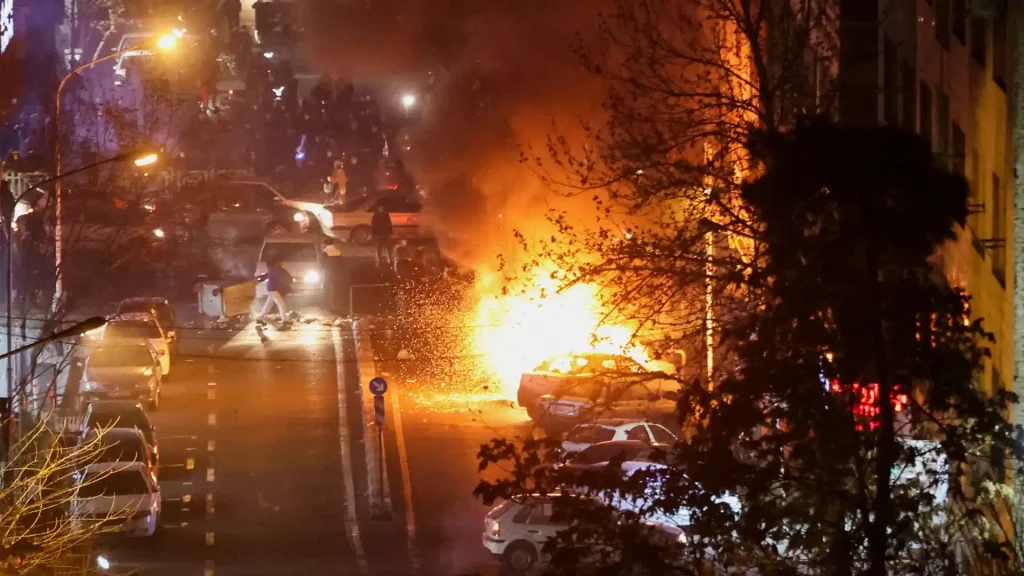
In a move that has sent ripples through the international community, U.S. President Donald Trump has effectively shuttered diplomatic channels with Tehran. On Tuesday, January 13, 2026, the President issued a directive via Truth Social, urging Iranian citizens to continue their nationwide demonstrations and promising that external assistance is forthcoming.
The Message: Encouragement and Silence
The President’s message was blunt, calling on “Iranian patriots” to persist in their efforts to “take over” government institutions. While the phrasing “help is on its way” suggests a significant shift in U.S. policy, the administration has yet to define what this “help” entails—whether it be increased sanctions, cyber support, or direct military intervention.
Simultaneously, Trump announced the cancellation of all scheduled high-level meetings with Iranian officials. He stated that this diplomatic freeze would remain in place “until the senseless killing” of demonstrators is brought to a halt.
Background: A Nation at the Breaking Point
To understand the gravity of these statements, one must look at the events of the past year. The current unrest is not happening in a vacuum; it is the culmination of years of economic pressure and military tension.
- Operation Midnight Hammer (2025): In June of last year, a joint U.S. and Israeli bombing campaign targeted key Iranian nuclear facilities and military command centers. While the administration claimed the strikes “obliterated” Tehran’s nuclear ambitions, the resulting regional instability and hardened domestic rhetoric created a volatile environment.
- The Economic Trigger: The latest wave of protests began in late December 2025, sparked by a catastrophic collapse of the Iranian rial. With inflation skyrocketing and food prices becoming untenable, what began as an economic outcry has evolved into a direct challenge to the clerical establishment.
The Human Cost: A Disputed Toll
As with many conflicts involving a near-complete internet blackout, the true scale of the violence remains a subject of intense debate.
- Official Reports: An Iranian official recently informed Reuters that the death toll has reached approximately 2,000. However, the state blames these deaths on “terrorists” targeting both civilians and security forces.
- Human Rights Estimates: Independent rights groups have provided lower, yet still devastating, figures ranging from 500 to 600 verified deaths.
This discrepancy highlights a core debate: Is the violence a result of rogue elements within the protests, or is it a calculated, systemic crackdown by a regime fighting for survival?
Analysis: Potential for Reform or Regime Resilience?
President Trump’s intervention brings up a critical question for analysts: Does foreign encouragement empower the protesters, or does it allow the Iranian government to paint the movement as a “foreign-led plot”?
While the street unrest is the most significant since 2022, several geopolitical sources suggest that the establishment remains resilient. Unless the pressure prompts high-level defections among the military or the clerical elite, the status quo—though severely weakened may persist.
The President’s promise of “help” sits at the center of this uncertainty. If the help is purely rhetorical, it may lead to further disillusionment. If it is military, it risks a broader regional conflict in a zone already scarred by the strikes of 2025.
______________________________
In other news, Le Pen Appeals for 2027 Eligibility


 Armenian Dram
 Ghana Cedi
 Gambian Dalasi
 Guinea Franc
 Nigerian Naira
 CFA Franc BEAC