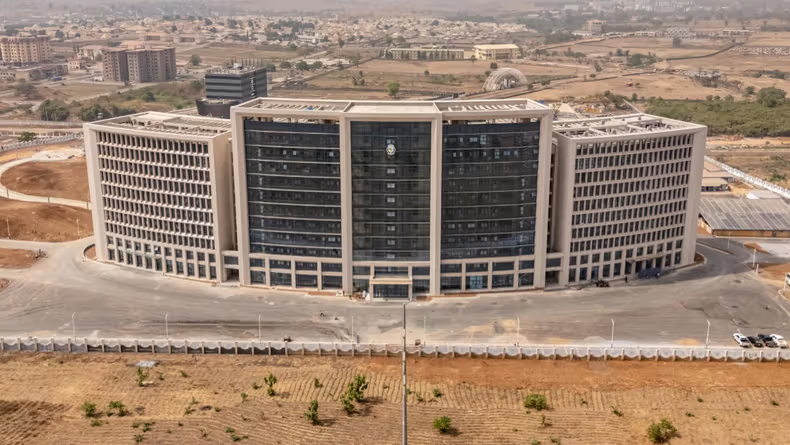
China has officially handed over a newly completed $56.5 million headquarters complex to the Economic Community of West African States in Abuja, marking a major milestone in Beijing’s expanding footprint across West Africa.
The state-of-the-art facility, funded by the People’s Republic of China and delivered in under two years, is expected to serve as the central administrative hub for the 15-member regional bloc.
At the handover ceremony, China’s ambassador to Nigeria, Yu Dunhai, described the project as a flagship intervention aimed at strengthening institutional capacity within ECOWAS and supporting regional development efforts.
He framed the initiative as part of China’s broader cooperation strategy with Africa, emphasizing a policy of “non-interference” and partnerships without political conditions.
“This project provides a solid foundation for ECOWAS to advance its regional goals,” Yu said, adding that China remains committed to supporting African-led development models and amplifying the continent’s voice globally.
President of the ECOWAS Commission, Omar Touray, who received the facility on behalf of member states, commended the speed and quality of execution, noting that Chinese and regional engineers worked collaboratively to deliver the project on schedule.
He described the complex as a landmark achievement that will enhance coordination and efficiency within the organisation, particularly at a time of increasing regional challenges.
The headquarters is expected to be formally inaugurated later this year by Julius Maada Bio, current Chair of the ECOWAS Authority of Heads of State and Government, alongside Bola Ahmed Tinubu and other regional leaders.
Nigeria’s Minister of State for Foreign Affairs, Bianca Odumegwu-Ojukwu, described the project as a clear reflection of deepening relations between China and West Africa, highlighting continued collaboration in infrastructure and institutional development.
The handover comes amid rising Chinese investment across Africa, particularly in public infrastructure, energy, and government facilities. While analysts often interpret such projects as part of Beijing’s broader geopolitical strategy, Chinese officials maintain they are demand-driven partnerships aimed at mutual benefit.
For ECOWAS, the new headquarters is expected to strengthen its operational capacity and improve coordination among member states, as the bloc navigates issues such as political instability, economic integration, and regional security.








 Armenian Dram
 Ghana Cedi
 Gambian Dalasi
 Guinea Franc
 Nigerian Naira
 CFA Franc BEAC