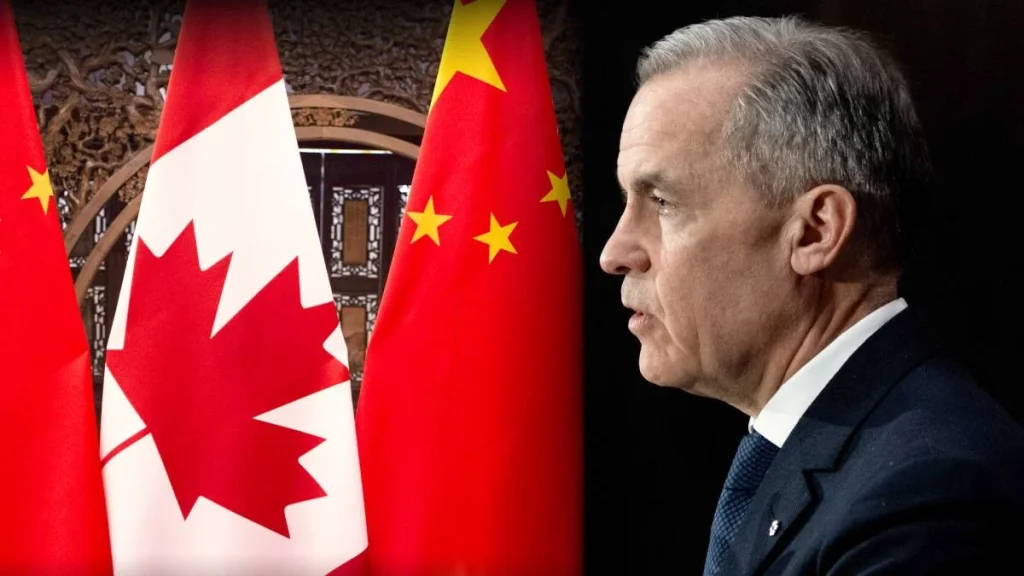
In a decisive move to reduce economic reliance on the United States, Prime Minister Mark Carney has signed a sweeping energy framework with Chinese leadership. The agreement, finalized Thursday in Beijing, headlines the Mark Carney China visit 2026, marking the first time a Canadian leader has visited the superpower since 2017.
Carney declared a “new era of relations” following talks with Premier Li Qiang. This strategic pivot aims to insulate Canada’s economy from the volatility of “global division and disorder” by securing alternative markets for its vast natural resources.
Escaping the Shadow of U.S. Tariffs
The urgency behind this diplomatic reset is driven by pressure from Washington. With U.S. President Donald Trump enforcing new tariffs and questioning the future of the USMCA, Ottawa is scrambling to protect its financial interests.
Currently, Canada sends approximately 75% of its exports south of the border. By strengthening ties with China—already its second-largest trading partner—the government hopes to build a trade profile that is resilient to American political shifts.
Inside the New Economic Road Map
The newly signed “economic and trade co-operation road map” prioritizes pragmatism over politics. It opens the door for Chinese investment in Canadian agriculture and consumer goods while boosting Canadian exports in critical sectors.
Key components of the framework include:
- Energy Expansion: Increased trade in oil, liquefied natural gas (LNG), and natural uranium.
- Tech Transfer: Beijing’s interest in Canadian aerospace, new materials, and advanced manufacturing.
- Investment Flows: Reduced barriers for Chinese capital entering Canadian energy markets.
Natural Resources Minister Tim Hodgson emphasized the strategic alignment. He noted that Beijing seeks trading partners who will not use energy exports as tools for “political coercion,” creating a lucrative opening for Canadian suppliers.
Resolving Trade War “Irritants”
Despite the handshake deals, significant friction remains. Both nations are still locked in a tit-for-tat tariff dispute that began in 2024 when Canada imposed a 100% levy on Chinese Electric Vehicles (EVs). China retaliated in 2025 with heavy duties on Canadian canola and farm products.
Industry Minister Mélanie Joly confirmed that negotiations to dismantle these barriers are active. While Thursday yielded no immediate truce on tariffs, officials from both sides pledged to resolve these “trade irritants” through dialogue rather than further escalation.
The Road to Xi Jinping
This high-stakes Mark Carney China visit 2026 is not yet over. The four-day mission concludes Friday with a critical meeting between Carney and President Xi Jinping.
Observers view this upcoming session as the final test for Carney’s gamble. Success could redefine Canada’s foreign policy for decades, balancing economic necessity against national security concerns in an increasingly fragmented world.







 Armenian Dram
 Ghana Cedi
 Gambian Dalasi
 Guinea Franc
 Nigerian Naira
 CFA Franc BEAC