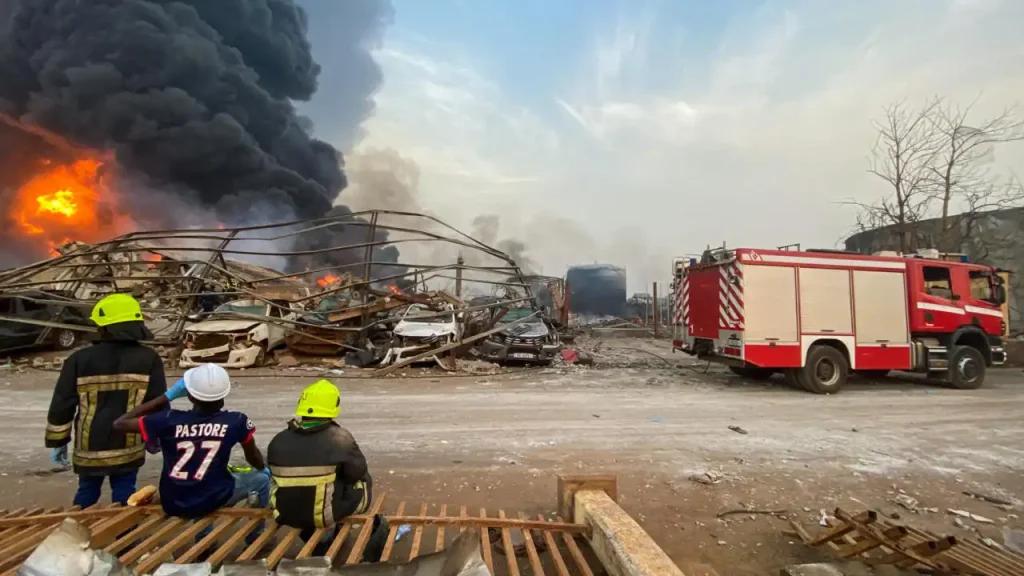
For the families living in the shadow of the towering municipal waste dump in Conakry’s Dar Es Salam neighborhood, the simple act of breathing has become a daily fight for survival.
For years, the community has been blanketed by thick, noxious smoke billowing from the constantly burning trash mountain. As the site continues to expand, encroaching further upon homes, businesses, and schools, residents are increasingly terrified of the long-term health catastrophe unfolding on their doorsteps.
A Community Choking
The physical toll of the pollution is undeniable for residents like Daouda Sylla. He describes his daily life as a distressing ordeal where even resting offers no reprieve.
“Simply sitting affects my lungs as if a fire was burning inside,” Sylla explained in Susu. “Even more so when I take a walk of 20 to 30 meters; it becomes a real problem.”
Sylla suffers from sleepless nights wracked by coughing fits, with cold water providing the only fleeting relief. The toxicity of the air is so severe that hospital doctors frequently advise him to stop smoking and drinking vices Sylla insists he does not practice. The “smoke” destroying his lungs comes not from cigarettes, but from the air in his own home.
The Vulnerable Pay the Price
The crisis is hitting the community’s children the hardest. Their developing lungs leave them particularly susceptible to the acrid fumes that dominate the horizon.
Mamadama Bangoura reports that her young son, Djibril, has been chronically ill since he was six months old. The dump’s emissions have effectively turned him into a prisoner in his own house.
“This child is often disturbed by the smoke coming from the dump. That’s what exhausts him,” she said. “Every time he goes outside and breathes in the air, he first suffocates and then has a crisis that lasts two days.”
The situation has become so critical that the family often has to administer oxygen to the boy. “He doesn’t even go outside anymore,” she lamented.
“Slowly Killing the Population”
Medical experts in the area validate the residents’ fears. Nyan Balamoun Gobou Tokpa, a pulmonologist at a local clinic, confirms that the pollution is driving a surge in severe respiratory conditions, including pneumonia and chronic obstructive pulmonary disease.
Dr. Tokpa offered a grim prognosis for the future, warning that the local population faces a high risk of developing bronchopulmonary cancer in the long term. The dump, he stated bluntly, “is slowly killing the nearby population.”
A Contrast to National Progress
This environmental emergency is unfolding against a backdrop of promised national renewal. Guinea’s military leader, Gen. Mamadi Doumbouya, has aggressively promoted an agenda of development since his 2021 coup.
While many in Conakry have applauded recent infrastructure upgrades, such as road repairs, and the potential wealth from the “Simandou 2040” iron ore initiative, the residents of Dar Es Salam feel left behind. For them, economic projections mean little without clean air.
Nana Rachel Bangoura, a representative of the Citizen Collective for a Healthy Environment, is leading the call for urgent government intervention.
“We demand that the general come to our aid and help us remove this dump from Dar Es Salam. Because today, we are suffering,” she stated, standing amidst the smoldering waste. “We are tired of living in Dar Es Salam. But we have our homes in Dar Es Salam. We cannot leave.”
For these families, the hope is that the nation’s new era of development will eventually include the basic human right to breathe.




 Armenian Dram
 Ghana Cedi
 Gambian Dalasi
 Guinea Franc
 Nigerian Naira
 CFA Franc BEAC