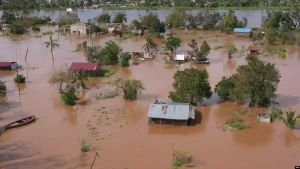
Mozambique is facing its worst flooding in decades, just months after emerging from a prolonged drought, as torrential rains cut off entire communities and overwhelm humanitarian response efforts.
Nearly 700,000 people have been affected nationwide, with more than 100,000 displaced into temporary shelters after floodwaters submerged homes, farmlands, and key road networks, according to the United Nations.
Aid agencies warn that severe overcrowding in shelters is creating dangerous conditions, particularly for women, girls, the elderly, and persons with disabilities, who face heightened risks of violence, exploitation, and lack of access to basic services.
UN Agencies Struggle to Reach Isolated Areas
The World Food Programme (WFP) says it is scaling up operations to provide life-saving food and nutrition assistance to 450,000 people, but urgently requires $32 million to sustain the response.
To reach communities cut off by collapsed bridges and washed-out roads, humanitarian teams are deploying specialised vehicles, boats, trucks, aircraft, and helicopters, highlighting the scale of the logistical challenge.
Despite these efforts, UN agencies caution that the situation remains volatile.
“With more rainfall forecast, further displacement is likely,” the UN said, stressing that urgent international support is critical to prevent the crisis from deepening.
Funding Gaps Threaten Emergency Response
Ross Smith, WFP’s Emergency Response Chief, warned that funding constraints are severely hampering relief efforts.
“Funding is down by 40 percent compared to last year,” Smith said, noting that the shortfall is limiting the agency’s ability to respond effectively at a time of escalating need.
The UN Refugee Agency (UNHCR) is also appealing for $38.2 million for 2026 to provide protection, shelter support, and essential services in overcrowded camps, where vulnerable populations remain at risk.
Crisis Far from Over
Humanitarian agencies emphasize that Mozambique’s flood emergency is far from over, with continued rainfall threatening to displace thousands more and further strain already overstretched resources.
As communities remain isolated and basic infrastructure lies in ruins, the UN is urging swift global action to prevent the unfolding disaster from turning into a prolonged humanitarian catastrophe.






 Armenian Dram
 Ghana Cedi
 Gambian Dalasi
 Guinea Franc
 Nigerian Naira
 CFA Franc BEAC