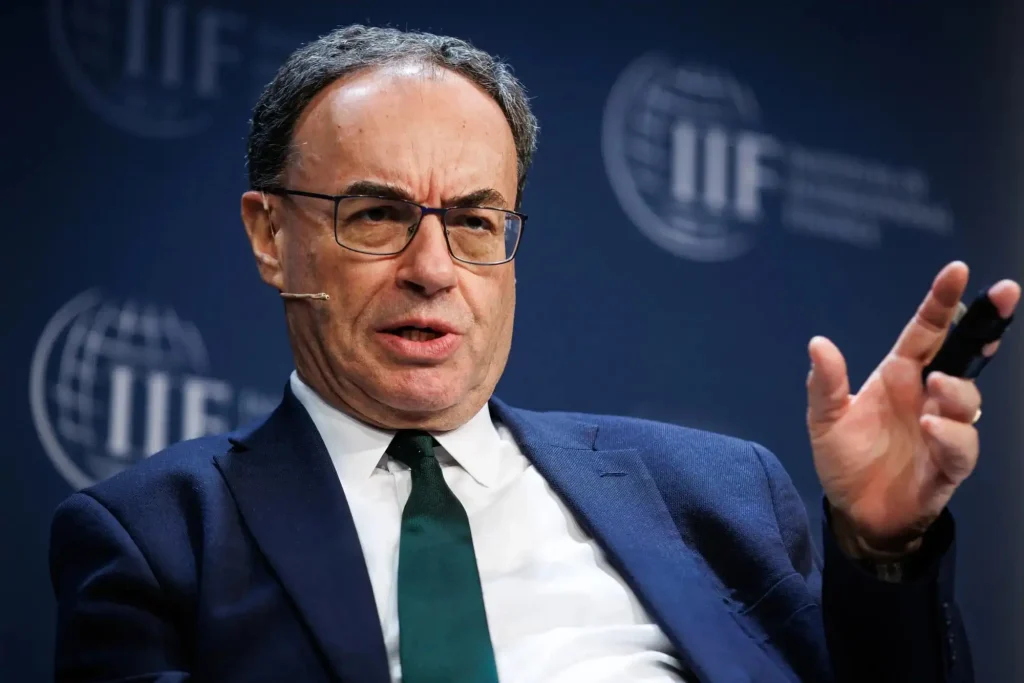
Bank of England Governor Andrew Bailey has charted a distinct path for the UK economy. He signals a determination to continue shrinking the central bank’s balance sheet, even as his American counterparts stop.
This marks a clear divergence from the U.S. Federal Reserve. The Fed halted its own quantitative tightening (QT) program on December 1. In contrast, Bailey indicated that the BoE aims to remove the remaining £553 billion ($740 billion) in government bond holdings from its books.
His objective is structural. He wants to strip interest rate risk from the public balance sheet and transfer it back to the private sector.
Shifting the Risk to Protect Taxpayers
Between 2009 and 2021, the BoE printed money to buy £875 billion in gilts (bonds) to support the economy. Since 2022, it has successfully sold off over £300 billion of this debt.
The Governor’s aggressive stance aims to protect the public purse.
When the central bank holds vast amounts of government debt, rising interest rates cause problems. The Bank must pay out more on reserves than it earns on the bonds. This mismatch has already exposed taxpayers to potential losses estimated at £120 billion.
Bailey argues that the public should not bear this volatility.
“From the point of view of the public balance sheets in this country, we should not have interest rate risk on our balance sheet,” Bailey asserted.
The ‘Repo’ Future
Bailey envisions a new system to replace the era of Quantitative Easing.
He proposes a “repo-backed” system. Under this model, the central bank does not hold the bonds directly. Instead, commercial banks hold the gilts.
If these banks need liquidity (cash reserves), they can temporarily borrow from the BoE. They use their gilts as collateral for these loans.
“A repo-backed stock of reserves puts the interest rate risk into the private sector, which is where it should be,” Bailey explained.
Pushing Past Equilibrium
The central bank is currently approaching the “preferred minimum range of reserves.” This is the theoretical floor of cash needed for the banking system to function.
Many economists expected the BoE to stop selling bonds once it reached this level. However, Bailey suggested he plans to push further.
He indicated that the reduction of the bond stockpile should continue. He wants to replace direct holdings with the repo facilities mentioned above.
Contrast with the US
This approach highlights a sharp contrast in global central banking strategies.
- The US Approach: The Federal Reserve stopped shrinking its balance sheet this month. They prioritized liquidity and stability.
- The UK Approach: The BoE is pressing ahead with sales of £70 billion a year. Bailey prioritizes removing long-term risk over maintaining short-term reserve stability.
Some investors have urged the BoE to pause sales to minimize immediate losses. However, Bailey contends that halting now would lock the Bank into paying higher interest rates on reserves indefinitely.
READ MORE: NFF Assures Coach Chelle of Payment as AFCON Camp Opens










 Armenian Dram
 Ghana Cedi
 Gambian Dalasi
 Guinea Franc
 Nigerian Naira
 CFA Franc BEAC