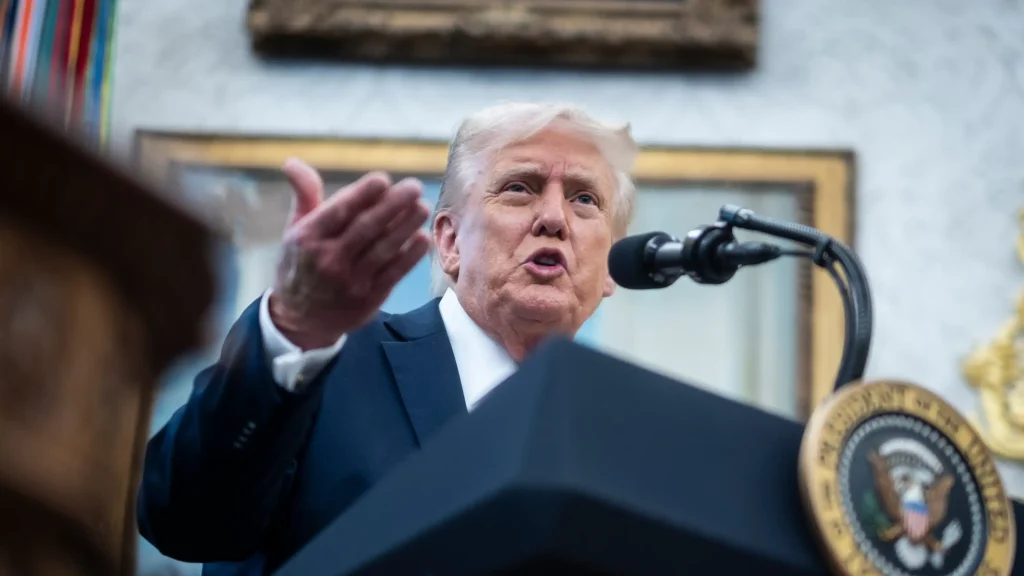
President Donald Trump has put the world on notice. The United States is ready to trade sanctions for airstrikes in the war on drugs. This stunning escalation has sent shockwaves through diplomatic channels across the Western Hemisphere.
During a tension-filled cabinet meeting on Tuesday, the President ignored traditional diplomatic red lines. He moved far beyond the usual threats of tariffs. instead, Trump issued a chilling ultimatum to nations failing to curb narcotics production.
He specifically named Colombia, a major cocaine producer. “Anybody that’s doing that and selling it into our country is subject to attack,” Trump declared. This statement stunned the room of reporters and officials.
The “Kinetic” Option is on the Table
The use of the word “attack” marks a seismic shift in American foreign policy. For decades, Washington treated drug trafficking as a law enforcement issue. Authorities solved it with cooperation, aid, and police work.
However, Tuesday’s declaration redefines the drug trade. Trump now views it as unconventional warfare against the American people. Consequently, he believes it requires a military response.
Defense insiders are already scrambling to interpret the directive. The phrase “subject to attack” raises urgent questions:
- Does it mean drone strikes on coca labs in South America?
- Does it imply naval bombardments of smuggling vessels?
- Is the White House considering special forces incursions without permission?
This aggressive posture aligns with the administration’s frustration over the fentanyl and cocaine epidemic. By framing narcotics as a “chemical weapon,” the President is laying the groundwork for unilateral military intervention.
Colombia in the Crosshairs
The immediate target of this rhetoric is Colombia. Once Washington’s staunchest ally, the relationship has fractured under Colombian President Gustavo Petro. Petro’s approach focuses on public health rather than militarized eradication.
Trump’s comments suggest that patience with Bogotá has run out. He explicitly raised the issue of Colombian cocaine before delivering his threat. Effectively, the President has placed a target on the back of the South American nation.
The silence from Bogotá has been deafening. As of Tuesday evening, neither the Foreign Ministry nor President Petro’s office had responded.
Diplomatic sources suggest the Colombian government is in crisis mode. They are analyzing whether the U.S. President is engaging in hyperbole or planning actual strikes within their borders.
A New Era of “Gunboat Diplomacy”
This ultimatum represents a return to “gunboat diplomacy,” but with modern weaponry. The implications for international law are staggering.
If the U.S. follows through, it would be claiming the right to bomb sovereign nations. The justification would be their inability to control criminal organizations.
Critics warn this could ignite a regional conflict. Furthermore, it could drive Latin American nations toward rivals like China or Russia. However, supporters argue the U.S. has a moral obligation. With over 100,000 Americans dying annually from overdoses, they believe the U.S. must destroy the supply chain at its source.
One thing is certain: the rules of the drug war have changed. The era of diplomatic notes is over. The era of the drone strike may have just begun.
READ ALSO: Elon Musk Calls for Reform, Not Removal, of H-1B Visa Program










 Armenian Dram
 Ghana Cedi
 Gambian Dalasi
 Guinea Franc
 Nigerian Naira
 CFA Franc BEAC