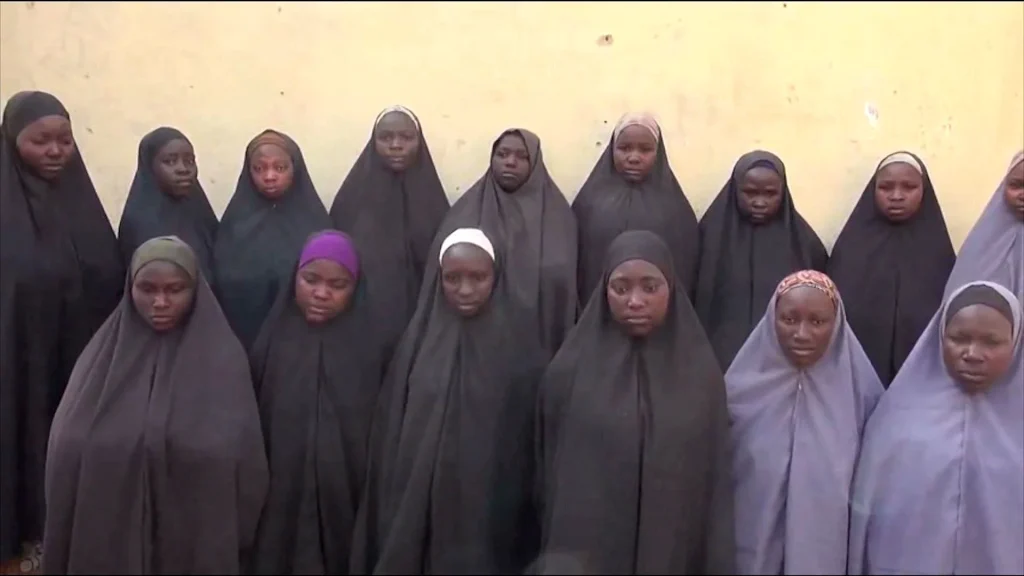
11 years! Over 1,500 schoolchildren kidnapped. Yesterday, 25 more girls vanished in Kebbi. This is the story every West African parent fears.
Keep scrolling – you need to see how it started, why it never stopped, and who is still missing today.
The Nightmare Begins: Chibok, 2014 – Boko Haram’s Global Wake-Up Call
It was April 14, 2014, in the dusty town of Chibok, Borno State. Boko Haram militants, railing against Western education as a sin, raided Government Girls Secondary School under cover of darkness. They loaded 276 terrified girls some as young as 11 – into trucks and vanished into the Sambisa Forest.
The world erupted in outrage. #BringBackOurGirls trended globally, with celebrities like Michelle Obama holding placards. But rescue efforts faltered. Over the years, 82 girls escaped on their own, and 103 were freed in prisoner swaps between 2016 and 2017.
Tragically, 91 remain missing or captive, many forced into marriages or used as fighters. The Chibok saga didn’t just scar families; it highlighted Boko Haram’s brutality, killing thousands and displacing millions in the northeast insurgency.
Dapchi Déjà Vu: 2018 – Another 110 Girls Snatched
Four years later, in February 2018, history repeated itself in Dapchi, Yobe State. A Boko Haram faction targeted Government Girls Science and Technical College, abducting 110 girls during assembly. Eyewitnesses described militants in military uniforms luring the students out, then bundling them onto motorcycles and trucks.
Unlike Chibok, hope flickered briefly. Most girls were released a month later in a negotiated swap, though five died in captivity and one converted to Islam under duress. The incident exposed glaring intelligence lapses the attackers drove through army checkpoints unchallenged. It reignited global calls for action, but the pattern of impunity persisted.
Kankara: 2020 – The Shift to Banditry in the Northwest
By December 2020, the threat had migrated west. In Kankara, Katsina State, gunmen on motorbikes stormed Government Science College, kidnapping over 344 boys – a rare gender twist in the saga. The attackers, identified as Fulani bandits rather than jihadists, demanded millions in ransom amid a wave of rural violence over land and cattle.
After two weeks of tense negotiations, the boys were freed without payment, though details remain murky. This mass abduction marked the northwest’s entry into the kidnapping epidemic, where criminal gangs, fueled by poverty and arms proliferation, began targeting schools as soft, lucrative hits.
Bethel Baptist: 2021 – Faith Under Fire in Kaduna
July 2021 brought double horror to Kaduna State. First, over 140 students were seized from Bethel Baptist High School in Chikun. The Anglican school, a beacon for Christian education in a tense region, saw gunmen scale fences and herd pupils into the bush.
The captives endured two months of captivity, with ransoms haggled from ₦890 million ($2.1 million) down to ₦100 million. All were eventually released, but not before families sold assets and endured threats. Just weeks later, 160 more students vanished from a primary school in Tegina, highlighting Kaduna’s vulnerability to inter-communal clashes and banditry.
Kuriga: 2024 – Over 400 Children Freed After Weeks in Captivity
Fast-forward to March 2024: Gunmen hit LEA Primary School in Kuriga, Kaduna, abducting 287 students (mostly boys) and a teacher. The attack, one of the largest in years, sparked nationwide fury and international headlines.
After 16 harrowing days – marked by reports of forced marches and minimal food – the military rescued 137 students in Zamfara State. The rest were freed through negotiations, though rumors of ransom payments swirled. President Bola Tinubu vowed to end the scourge, but critics pointed to delayed responses as a recurring failure.
The Latest Blow: Kebbi, November 17, 2025 – 25 Girls Gone, One Hero Dead
In the early hours of November 17, 2025 – just yesterday as of this writing – the cycle spun again. At Government Girls Comprehensive Secondary School in Maga, Kebbi State, northwest Nigeria, gunmen armed with sophisticated rifles stormed the dormitories around 4 a.m. They exchanged fire with guards, scaled the fence, and abducted 25 Muslim schoolgirls.
Vice Principal Hassan Yakubu Makuku was shot dead while shielding the students; another staffer lies wounded. Police spokesperson Nafiu Abubakar Kotarkoshi confirmed the coordinated raid, and a multi-agency manhunt – involving soldiers, tactical units, and vigilantes – is scouring forests for escape routes. No group has claimed responsibility, but bandits are the prime suspects in this ransom-driven region.
The federal government condemned the attack, with Information Minister Mohammed Idris pledging enhanced security and regional cooperation via ECOWAS and the African Union. Families wait in anguish, echoing the cries from Chibok a decade ago.
A Decade of Fear: Why Schools Remain Targets
These abductions aren’t random; they’re symptoms of a fractured nation. Boko Haram’s ideological war in the northeast morphed into banditry’s profit-driven terror in the northwest, where weak policing and porous borders let gangs thrive. Over 1,500 students kidnapped since 2014; thousands more displaced or orphaned. The UN reports 6,800 children affected by grave violations in the northeast alone.
Girls bear the brunt – forced marriages, pregnancies, stigma upon return. Yet resilience shines: survivors like the Chibok escapees advocate for education, and communities rally with #BringBackOurGirls echoes.
Nigeria’s leaders promise action, but words outpace deeds. As the Kebbi girls’ fate hangs in the balance, one truth endures: until schools are safe havens, not hunting grounds, the stolen futures will keep mounting.
25 girls from Kebbi went missing yesterday. 91 from Chibok yet to come home.
As another school attack makes headlines, one question remains for every Nigerian and every West African neighbour:
What concrete steps are our governments taking today to finally make every classroom safe?











 Armenian Dram
 Ghana Cedi
 Gambian Dalasi
 Guinea Franc
 Nigerian Naira
 CFA Franc BEAC