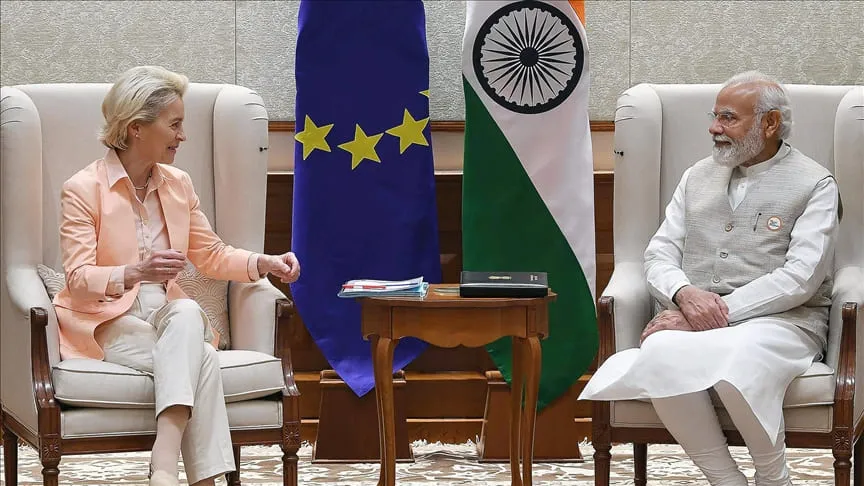
After nearly two decades of “will-they-won’t-they” negotiations, India and the European Union have finally closed the deal on a landmark trade pact. Set for an official announcement this Tuesday, the accord marks a major strategic pivot for both economies.
The agreement creates a massive free-trade corridor spanning 27 European nations and the South Asian powerhouse. Together, they represent a market of 2 billion consumers and one-quarter of the world’s GDP.
The Economic Engine: Trade by the Numbers
Trade between these two giants has been on a steady climb. In the fiscal year ending March 2025, trade reached $136.5 billion. This new deal is specifically designed to supercharge those figures.
Key Provisions of the Accord:
- Drastic Tariff Slashes: In a major win for European manufacturers, India will reduce import duties on vehicles from a staggering 110% down to 40%.
- Steel Industry Boost: India, a global steel leader, has secured a commitment from the EU to reduce trade barriers on its steel exports.
- Strategic Exclusions: To support millions of subsistence workers, sensitive agriculture and dairy sectors will remain excluded from the deal.
- Investment Flow: India’s Trade Secretary, Rajesh Agrawal, noted that the pact focuses on “better economic integration.” Consequently, it aims to propel both direct investment and goods exchange.
Geopolitical Hedging: The “Trump Factor”
The timing of this “historic” deal is no coincidence. As traditional Western alliances face pressure from shifting U.S. policies, India and the EU are choosing to shore up their own backyard.
Negotiations accelerated significantly after a 50% U.S. tariff was imposed on Indian goods and a separate India-U.S. trade deal collapsed last year. By finalizing this pact, New Delhi and Brussels are effectively hedging against market volatility in the West.
“It will be a balanced, forward-looking deal… propelling trade and investment between both sides,” stated Trade Secretary Agrawal.
The Road to Implementation
While the handshake is complete, the deal still requires a final legal review. Because the process is rigorous, it will take several months to finalize.
The Projected Timeline:
- Legal Vetting: This phase is expected to last 5 to 6 months.
- Formal Signing: The official ceremony is projected for Late Summer 2026.
- Full Implementation: Experts expect the deal to be fully active within 12 months.






 Armenian Dram
 Ghana Cedi
 Gambian Dalasi
 Guinea Franc
 Nigerian Naira
 CFA Franc BEAC