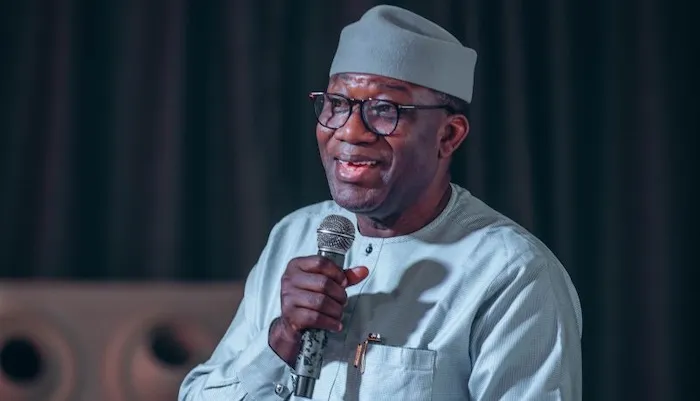
Former Ekiti State governor, Kayode Fayemi, has called for a major reset in Africa’s economic relationship with Western nations, urging leaders across the continent to prioritise industrialisation, local value addition and equitable partnerships.
Fayemi made the call while presenting a paper titled “Africa–West Relations at a Turning Point: Interests, Agency, and a New Bargain” at a high-level session during the Africa–Europe Strategic Dialogue held at the Sandton Convention Centre.
Currently a visiting professor at King’s College London, Fayemi argued that Africa must move beyond its long-standing role as a supplier of raw materials and instead negotiate agreements that promote local processing, manufacturing and technology transfer.
“Any new partnership framework must be anchored on industrialisation, local processing and technology transfer,” he said, stressing that such a shift aligns with the development paths historically taken by advanced economies.
Africa Must Control Its Resource Wealth
Fayemi warned that Africa risks repeating past economic mistakes if it fails to take control of its vast mineral resources—especially as global demand surges for materials critical to clean energy technologies.
He highlighted key resources such as cobalt, lithium, manganese, coltan and copper, noting that exporting them in raw form would mirror the continent’s oil-era experience, where wealth generation remained limited.
“The world cannot go green without first going African,” he said, urging policymakers to ensure the continent captures greater value from the global energy transition.
Demographics a Strategic Advantage
Fayemi also pointed to Africa’s rapidly growing population as a major bargaining tool in global negotiations. He projected that by 2050, one in four people worldwide will be African, positioning the continent as a key driver of future economic growth—if its human capital is properly harnessed.
However, he criticised what he described as a long-standing paternalistic approach in Africa-West relations, where major policy decisions affecting the continent are often shaped externally.
Call for Structural Reforms
While acknowledging efforts by partners such as the European Union through initiatives like the Global Gateway Strategy, Fayemi insisted that deeper reforms are needed.
He outlined priorities including sovereign debt restructuring, improved access to development finance, fair labour migration frameworks, and stronger technology partnerships.
On digital transformation, he cautioned that Africa must not remain a passive consumer of global innovation, particularly in emerging fields like artificial intelligence and digital infrastructure.
Strengthening Internal Systems
Fayemi emphasised that Africa’s push for a fairer global deal must be matched by internal reforms, including stronger institutions, adherence to the rule of law, gender inclusion and youth empowerment.
“Weak institutions and exclusion carry economic costs and weaken our negotiating position. A new global bargain must go hand in hand with a renewed social contract with our own citizens,” he said.
His remarks come amid growing calls for Africa to redefine its place in the global economy and negotiate partnerships that deliver long-term, inclusive growth.







 Armenian Dram
 Ghana Cedi
 Gambian Dalasi
 Guinea Franc
 Nigerian Naira
 CFA Franc BEAC