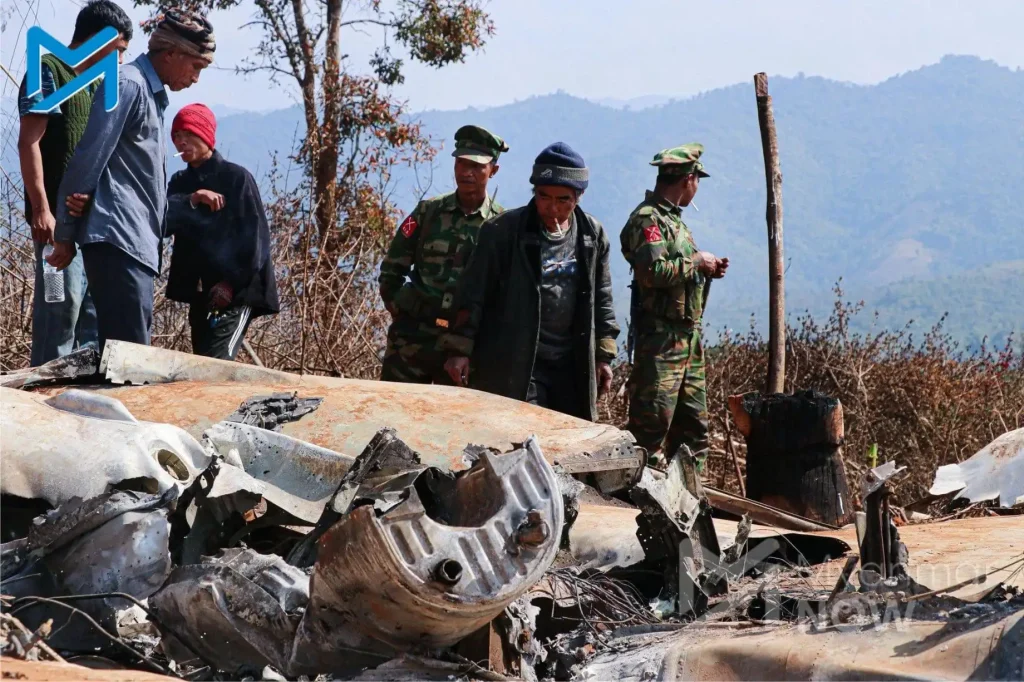
For seven harrowing days, Khant and his fellow rebel fighters held their ground.
They faced a relentless barrage of artillery and drone strikes from Myanmar’s military, an intensity unlike anything the veteran fighter had seen since the 2021 coup.
This battle for Pazun Myaung, a village strategically located between the country’s largest city and its political capital, marked a turning point.
According to Khant and Htike, another fighter present at the scene, the airstrikes were merely the prelude. Following the bombardment, wave after wave of infantry descended upon their positions.
“It was essentially an offensive using all the power they could muster,” Htike recalled.
After a week of heavy casualties, the rebels were forced to retreat. This defeat signals a shifting tide in Myanmar’s civil war. Two years after a major opposition offensive swept through the borderlands, the junta appears to have found its footing.
New Tactics: Human Waves and Drones
Interviews with six rebel fighters and three security analysts reveal that the military has reshaped its strategy.
Fighters on the ground report witnessing “human wave” maneuvers—a brutal tactic where soldiers are sent forward in overwhelming numbers to exhaust rebel defenses.
“After one soldier died, another one came up to take his place,” Khant said of the October clashes. He noted that some soldiers appeared to be advancing under threat from their own commanders, a stark contrast to previous encounters where junta troops would flee once losses mounted.
Technological superiority is also playing a key role. The military has significantly expanded its fleet of unmanned aerial vehicles (UAVs).
According to the Armed Conflict Location & Event Data Project (ACLED), the junta now deploys at least 19 different drone models, sourced from China, Russia, and Iran. These drones are used for both suicide missions and surveillance, providing intelligence that allows for more precise conventional airstrikes.
Conscription and Command Overhaul
Manpower shortages were once a critical weakness for the junta, but a mandatory conscription law introduced in February 2024 has begun to fill the ranks.
Since the law’s enactment, an estimated 70,000 to 80,000 recruits have entered the military. The junta has conducted roughly 16 rounds of conscription, calling up batches of 5,000 recruits at a time.
Furthermore, the military hierarchy has undergone a significant shake-up. Following embarrassing defeats during Operation 1027, inexperienced officers promoted through favoritism were replaced by battle-hardened commanders.
Min Zaw Oo, executive director of the Myanmar Institute for Peace and Security, noted that these changes have allowed units to rotate and rest—a luxury they did not have in the immediate aftermath of the coup.
The China Factor
Beyond battlefield tactics, geopolitical support has been crucial.
While Beijing maintains ties with some resistance groups, it has historically viewed the junta as a guarantor of stability. Recently, China has exerted diplomatic and financial pressure to stifle the rebellion.
Chinese officials have reportedly brokered ceasefires, including one that returned the strategic town of Lashio to junta control. Additionally, Beijing has pressured groups like the United Wa State Army (UWSA) to cut off weapons supplies to other resistance factions.
In the ruby-mining town of Mogok, this pressure is being felt acutely. Local fighter Sanay explained that restrictions on weapons have forced a halt in operations for some groups.
“If you look into the underlying reason why we can’t compete and are losing ground… it is ultimately due to pressure from China,” Sanay said.
A Volatile Future
These developments coincide with a general election scheduled for December 28. The United Nations and international rights groups have already dismissed the upcoming poll as neither free nor fair, citing the detention of opposition leaders like Aung San Suu Kyi.
As the election approaches, experts predict the junta will aggressively seek to reclaim more territory.
“We will see more armed clashes and more attempts from the military to retake territories in the coming three years,” Min Zaw Oo warned.
READ ALSO: Tunisia Recalls Veteran Maaloul for AFCON 2025 Campaign





 Armenian Dram
 Ghana Cedi
 Gambian Dalasi
 Guinea Franc
 Nigerian Naira
 CFA Franc BEAC